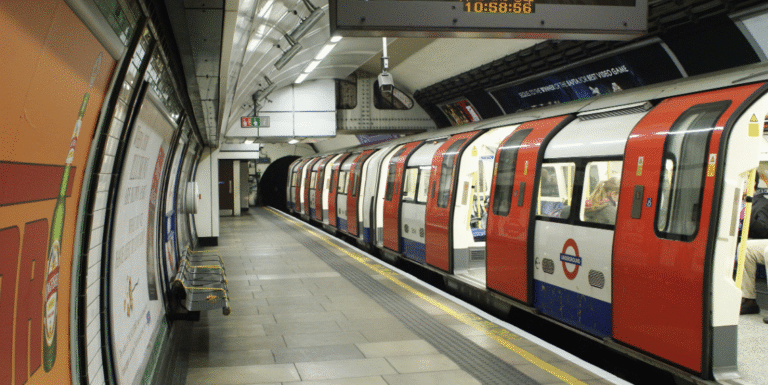
“If I can hear it without my hearing aids, that means it’s kind of loud,” Priscilla Baines said as her antique glass collection started to rattle from the Northern line tracks below her home.
“I hear it at 1.15am and I hear it if I go to bed at 11pm, I quite often read and I’m aware of it and I can feel my bed shaking.”
The afternoon rush hour has not even begun, but every 10 minutes Priscilla’s home in Kennington is overcome by a loud rumbling and deep vibrations as southbound Northern line trains on the Charing Cross branch head back up to begin a northbound journey.
Priscilla, whose 19th century house is located right over the Kennington Loop – a circuit on the Northern line that allows trains to turn around – told the Local Democracy Reporting Service (LDRS): “Sometimes it’s just an irritant, but for some people, it really upsets them.
“To have every time people come to the house and ask, what is it? Why? What’s happening? And sometimes there are people who live locally but don’t realise how bad it is.”
The Kennington Loop has been part of the Northern line service since it opened in 1926. Transport for London (TfL) has said the geometry of the Loop means the track is subject to wear from turning trains around to maintain a core service on the Northern line.
TfL has said that since the opening of the Northern line extension, the number of trains using the Loop has reduced by around 50 per cent.
A spokesperson for TfL said they have reduced noise levels through scheduled maintenance and specific engineering interventions.
They added: “As part of our work to reduce noise and vibration for residents near the Kennington Loop, we have removed insulated rail joints, installed new rails, moved signals to ensure trains stop in a different location and improved the condition of the track through rail grinding.
“As with all parts of our rail network, the challenge remains that the tracks are in constant use and subject to wear over time.”
But according to Priscilla, rail grinding only stops the noise for “about two weeks”.
She said: “I think TfL can’t just go into denial about it. It isn’t necessary for a start, there is a solution.
“It might be that they’d have to do some careful rescheduling so they didn’t need to use the Loop, but I can’t believe they’ve really tried.”
Tube noise recordings taken by TfL at Priscilla’s property last month show the latest noise levels for trains using the Loop reached 51 decibels, which is close to the highest levels previously recorded at her home.
Rail grinding was carried out in October 2025, but TfL’s recordings show noise has increased by 7 decibels.
Priscilla and her neighbours have raised their concerns with Labour London Assembly Member for Lambeth and Southwark, Marina Ahmad, and have asked TfL to consider reducing the use of the Loop.
Marina has urged TfL to come up with a long-term solution to the noise, and says it’s “absolutely incumbent” on TfL to meet with residents and visit their homes to listen to the noise.
Marina said: “I have been really insistent that senior TfL managers need to meet with my residents and explain to them what is going on and what the mitigations are because that’s the biggest thing at the moment.
“If you’re not going to stop using the Loop in the way that you originally said, what are you doing to make the Tube noise go away and make it palatable and acceptable to the people who have to live above it?”
She added: “It’s not just the noise, it’s that you can feel it. If you’re sitting and you’re having dinner, every few minutes everything starts vibrating and rattling.”
Marina, along with other Labour London Assembly Members, have been campaigning to raise awareness of the issue, which has been reported by residents living in other parts of London, including on the border of Westminster and Camden.
A TfL spokesperson told the LDRS: “We have met with residents in Kennington several times and have been in ongoing communication with a number of representatives for the area.
“We will continue to engage with local stakeholders as we identify other interventions that may help reduce noise levels.”