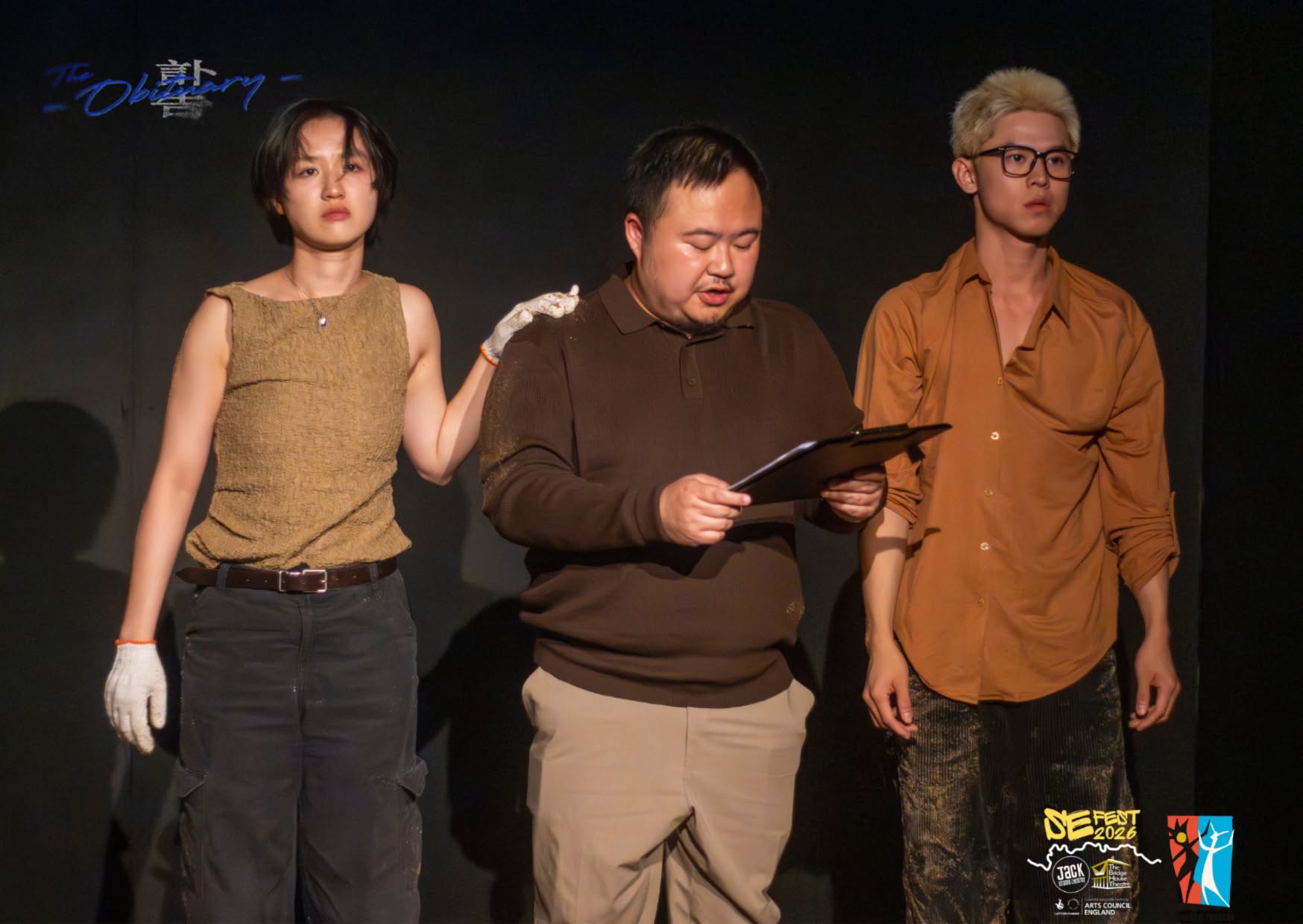
Standing on a sandy floor amidst a token of furniture, Lim (Kevin Ip) reads us the obituary of his mother, an unremarkable, good-natured, hardworking immigrant mother dedicated to her family, whose economic situation improved with time. But we are not in the UK, where she, aged 42, and her husband took the two children they had at the time, but back in China, in the humble abode that they had never let go of. Lim takes a moment to put himself into his mother’s shoes, imagining her starting out in life, without an inkling of the drastic change that life had in store for her. Black and white video footage of her when young forms an effective backdrop. Later, an interesting technical trick has both Lim’s siblings talking into a camera whose image is projected to create a backdrop, presenting us with multiple angles, writes Eleanor Thorn.
Joining Lim are Vanessa (Chen Yu) and Ethan (Yijia Gong), his siblings. Together, within the timeframe of the hour-long play, they must complete a property report for the authorities. The house is due for demolition, and debate is sparked: should they accept monetary compensation or another property? The sibling dynamics are in some ways universal, made more complex by the fact that unlike Lim and Vanessa, Ethan, “the lucky one,” was born and educated privately in the UK and feels no attachment to this house and this country, that he doesn’t consider himself a part of. Lim’s introductory monologue is explanatory and lengthy. Once with his siblings, communication between the three of them is tense and argumentative. Vanessa is marked by the arguments of their parents and recounts her difficulty in building trusting relationships. Her sibling brothers enact her with her partners, a rather surprising theatrical technique.
A couple of scenes were puzzling. When Vanessa, the middle sister, enters the stage, she is bowing her head and shuffling. Who is she, we wonder? Then why do Vanessa and Ethan drop lifeless to the floor and writhe in the sand whilst reacting verbally to the report being read out, right at the end? It is unclear and a little distracting: a desire for creative effect that leaves the audience confused as to its intention. Clarity is regained with the closing scene in which white petals are scattered in a mournful farewell ceremony and song.
This is a thought-provoking work that invites reflection on not only what it means to be part of an immigrant family but also what the meaning of home is, and how those impressions change according to one’s position within the family. My companion for the evening drew a parallel with her own situation not unlike Ethan’s: born in France, to parents who had left Spain with her older siblings and who had kept their property in Spain. China, of course, is further and the cultural divide greater. Any creative work that shines a light on the situation of immigrant families, at whatever stage, is a valuable one in these hostile times.