Originally sceptical of what I thought might be a ‘boys club’ type of piece, I am pleased to say that I thoroughly enjoyed watching Operation Epsilon. Written by Alan Brody and directed by Andy Sandberg, this UK premiere was performed at the new Southwark Playhouse Elephant, one of London’s largest fringe theatres, writes Bella Christy.
The play takes place in 1945 after the fall of Nazi Germany. Germany’s most important nuclear scientists have been rounded up by American and British intelligence, and detained in Farm Hall, an estate in England. Their reputation of advanced science has caused concerns about progress in nuclear fission, and the potential manufacturing of an atomic bomb. Based on real-life events, this play provides a blend of heated conflict, raw emotions and moral dilemmas.
Despite some scientific jargon, you need no interest nor knowledge of chemistry to be captivated by the production. As explained by director Sandberg: ‘the ideas and questions in the play aim to strike a chord with a broader audience’. This was certainly true for myself and my fellow theatregoer, who, as soon as leaving the auditorium, was eager to engage in conversation about the moral quandaries of science. Not something I expected of my Wednesday evening.
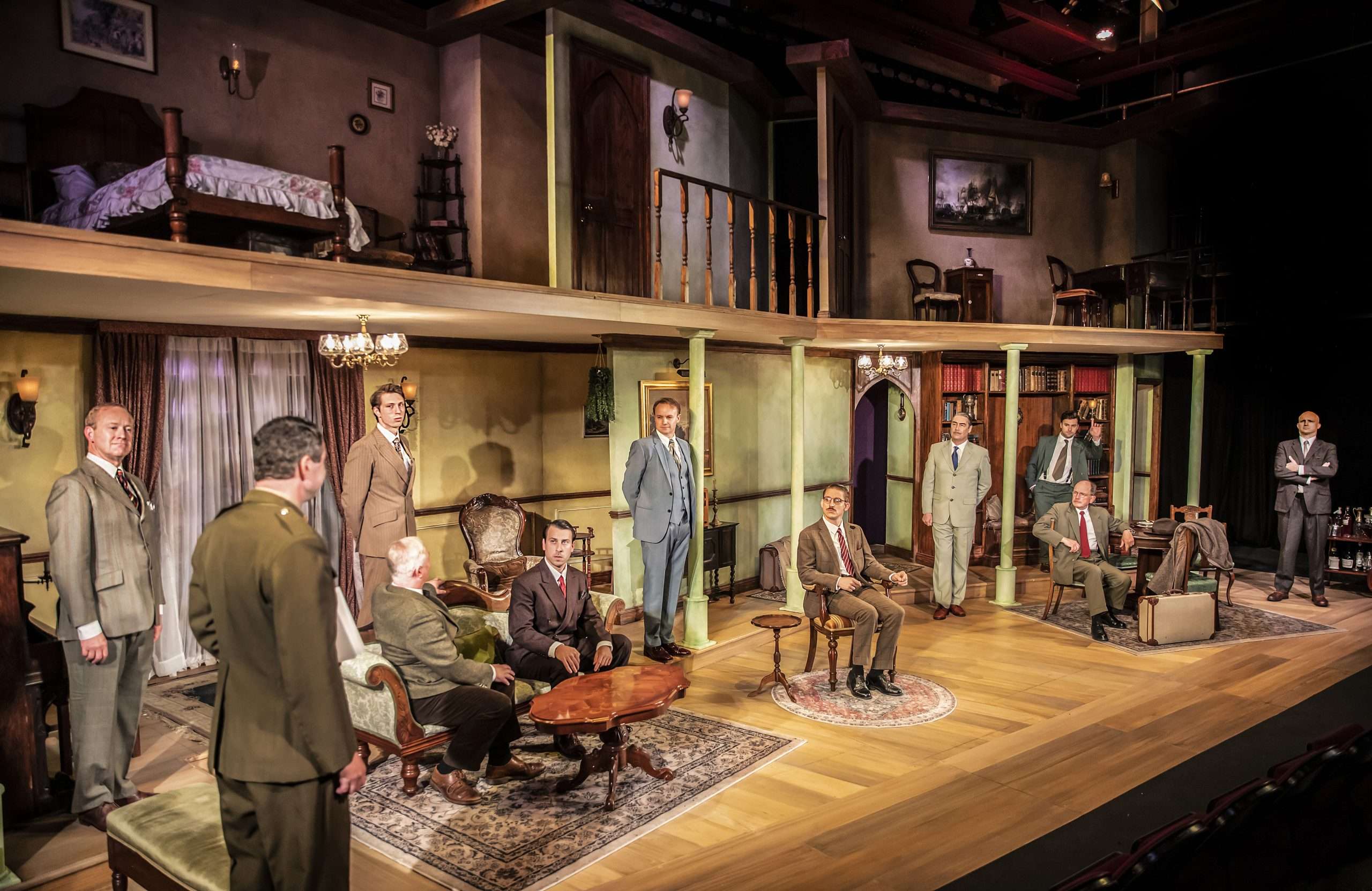
With eleven white men on stage, not markedly dissimilar from one another, my initial thoughts were concerned with how I would tell them apart and remember each of their characters. Though I needn’t have worried, after a creative theatrical device introducing each scientist, I found that their characters were written and performed with such detail and care that each man on stage had an impressively distinct characterisation. As well as that, the worries, relationships and conflicts portrayed on stage were familiar and identifiable, making the production all the more accessible.
Olivier Award winner, Nathaniel Parker, delivered an unreserved and poignant performance of Professor Otto Hans, while Simon Chandler’s portrayal of Professor Max von Laue exuded strength and self-assurance. Both Nicholas Armfield (as Doctor Horst Korsching) and Jamie Bogyo (Professor Friedrich von Weizacker) expertly portrayed youthful characters, their presence provoking the onstage conflicts, and Mathew Duckett’s portrayal of Doctor Erich Bagge was delightfully bratty in the best way possible. While there were characters with more leading roles, the production was largely reliant on the quality of the full cast. The play distinguishes itself as a compelling ensemble piece, with character dynamics and on-stage chemistry being particularly prominent.
I am pleased to note that women make up a large number of the creatives involved. Designer Janie E. Howland created a dynamic set, with attention to detail that wonderfully depicted the era. It was classy ‘grandma chic’. The stage design was innovative, with two levels allowing actors to occupy different areas without feeling overcrowded or stuffy.
After two acts of conflict and debate, the play concludes with Hans reading a letter from Lise Meitner, the sole female scientist mentioned in the play. Without revealing its contents, this letter provokes thought among both the characters on stage as well as the audience. It was a brilliant way to bring the play to a close.
Go check out the new Southwark Playhouse Elephant and watch Operation Epsilon.
Southwark Playhouse, Elephant, 1 Dante Place, London, SE11 4RX until 21st October. Times: Mon – Sat: 7.45pm; Thu & Sat: 2.30pm. Admission: Previews £16, full price £32, concessions £25.50.
Booking: southwarkplayhouse.co.uk – www.OperationEpsilon.com