How a bomb-scarred stretch of riverside became one of the world’s most dynamic cultural landscapes
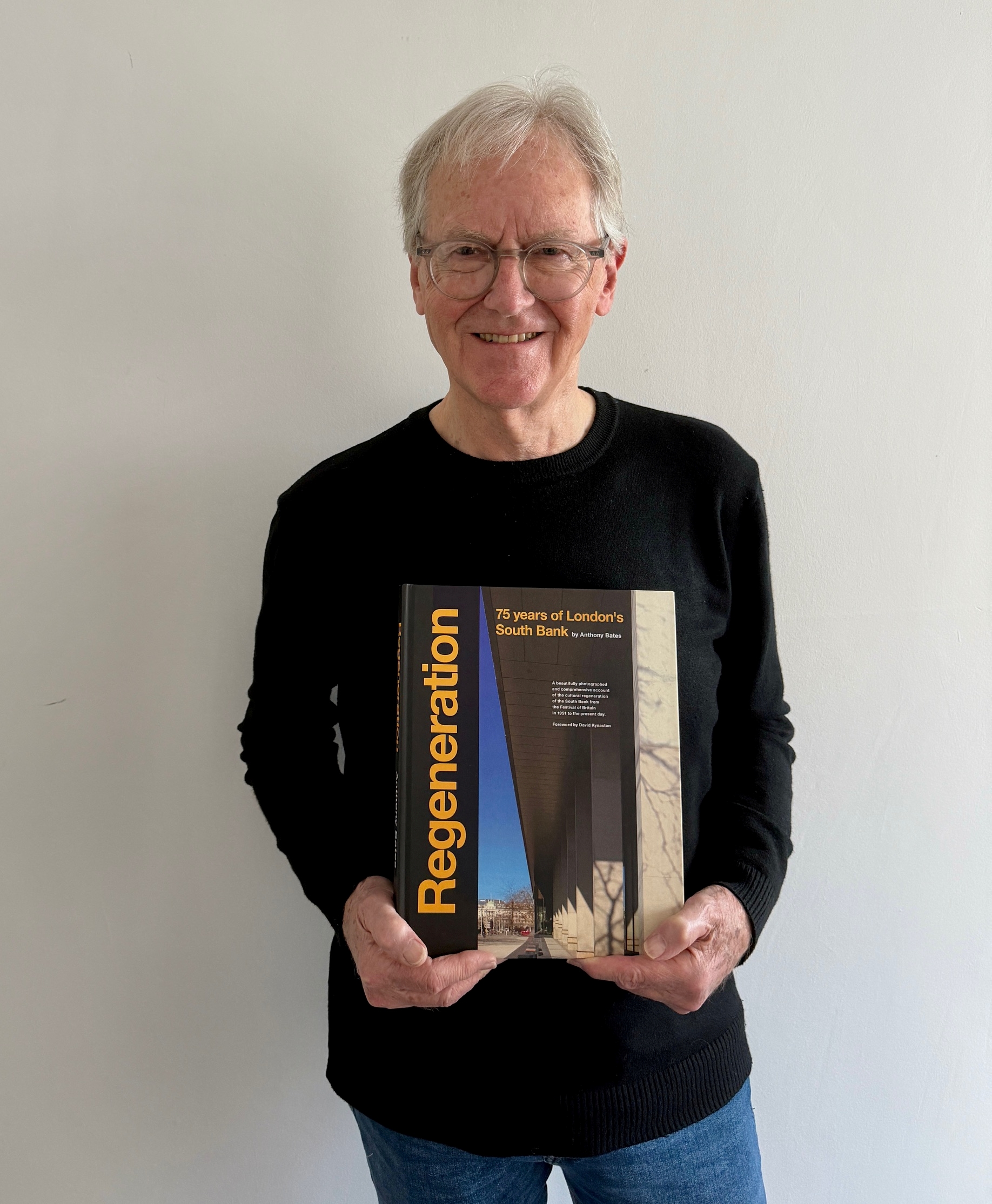
Anthony Bates grew up in the east of London and remembers being taken to the 1951 Festival of Britain on the South Bank, an event created to bring a bit of cheer to London after its devastation through the war, and to other areas of Britain where events were held. Much of what was built for the festival was temporary structures, but we have been left with the beautiful Royal Festival Hall building, a monument to modern design and the arts. Anthony Bates’ visit to that iconic event has culminated in a book to celebrate the transformation of the South Bank in those years, writes Michael Holland.
Anthony says his book, ‘Regeneration: 75 years of London’s South Bank’, is not academic but is 250 pages with over a hundred illustrations of the area from Westminster Bridge to Tower Bridge, and began when ‘as a four-year-old visiting the Festival it had such an impact on me; most of all the colour because Britain at that time just seemed to be grey.’
And while many of us have grown up with the changes along our stretch of the Thames, so the author has gone through his own changes: ‘I have always loved photography and as a young kid I entered and won competitions… On leaving education I qualified as a civil engineer but through a strange set of circumstances finished up in architecture.’
Not so strange is that Anthony is a photographer now and had been looking for a project to take on. ‘I read David Kynaston’s book “Austerity Britain”, which stirred a thought in me just how much the South Bank had changed over the last 75 years, with the Festival of Britain acting very much as the catalyst. So the die was cast and I put my love of photography and architecture together.’ Last year, Anthony had a photo awarded Photo of the Year 2025 by Ephotozine, and has had exhibitions nationwide.
The book has taken a year to write, with the research being ‘a mix of acquired knowledge, open source, Wikipedia, Google, and anything I could lay my hands on.’ The easy part was taking the photographs and the writing; it was getting his book published that created problems: ‘Publishing now, like so much else, is swamped with scammers, and so I decided to set up my own publishing company and do it myself.’
But Regeneration is out now, and Anthony describes it thus: ‘The purpose of this book is to illuminate the extraordinary evolution of London’s South Bank, tracing how a bomb-scarred stretch of riverside became one of the world’s most dynamic cultural landscapes. By following its journey from the optimism of the 1951 Festival of Britain through decades of architectural experimentation, political debate, artistic ambition, and community engagement, the book reveals not only what changed, but why it changed—and what those transformations say about London, its people, and its values. It offers readers a coherent narrative that connects iconic institutions, major redevelopment projects, and the quieter but equally essential stories of public space, accessibility, and everyday life along the Thames. What makes the book compelling is its combination of rich historical insight and vivid storytelling. The South Bank is a place everyone thinks they know—home to the National Theatre, Royal Festival Hall, BFI, Hayward Gallery, and countless festivals—yet few understand how hard-won and contested its regeneration has been. By weaving together archival discoveries, planning battles, cultural milestones, and personal observations, the book uncovers the ambition, risk, creativity, and political will that shaped the area. It brings to life the personalities and ideas behind the scenes while also capturing the emotional and social impact of the South Bank as a shared public realm. For policymakers and planners, it offers a case study in long-term cultural strategy; for Londoners and visitors, it reveals the hidden history of a beloved destination; and for general readers, it provides a compelling human story about reinvention and resilience. Ultimately, the book demonstrates how culture can drive meaningful regeneration—and why the South Bank stands as a powerful example of how cities can be rebuilt not just physically, but imaginatively.
Historian and author, David Kynaston, who was imperative to Regeneration ever coming to fruition, has written the foreword. He says, ‘Anthony has written a book to treasure, adding to our rich store of literature about one of the world’s greatest cities, arguably the greatest… To read Regeneration is indeed a life-enhancing experience.’
Anthony will be coming to Copleston Community Centre (in Copleston Church), Copleston Road, Peckham, SE15 4AN on 29th April at 2pm – 3.30pm to talk about his life, his work, and to sign copies of his book.
Email an*@*****************rg.uk to book your free place.
Out from 7th April on Amazon, Foyles, and other major online booksellers. Price: £35.
ISBN: 9781036955854