To speak or not to speak – or the power of loyalty, religion and cruelty
Now one of the biggest tourist attractions in the capital, the Tower of London once served as a prison and place of torture. Over 400 years ago and less than three miles away from White Bear Theatre, Jesuit priest Robert Southwell was one of many prisoners at the tower, and his story still speaks to us in 2026, writes Eugenia Sestini.
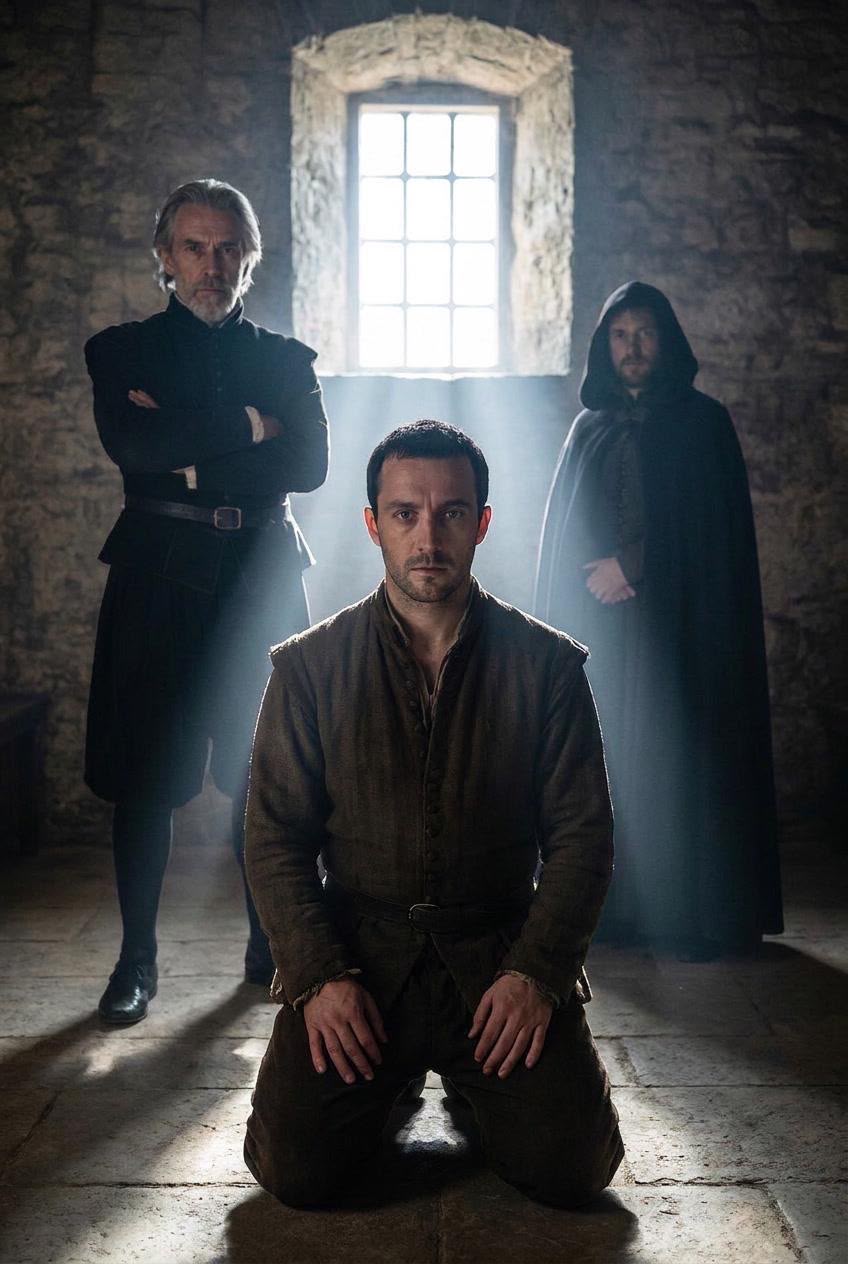
Shakespeare’s Cousin is a new historical play about loyalty, religion and cruelty, written and directed by award-winner Jonathan Moore. In an age of polarised opinions, toxic masculinity, cancel culture, metadata collection, and the rise of the far right, are we so much different from these characters from Elizabethan times? When Queen Elizabeth’s government monitors the population, controls what gets written, and enforces its laws through sheer brutality, how are men to react? Shakespeare’s Cousin is a two-hour three-hander that shows how different men respond to the challenges of their times.
The play opens to a simple set – a table between two chairs, some freshly baked bread on display, as well as a pewter tankard. We hear birds chirping as two men take the stage: Sir Richard Topcliffe welcomes Robert Southwell to his house, and offers him food while he comments on the fact that he is celebrating his daughter’s birthday and has written her a poem. Southwell was a respected author in the sixteenth century, and Topcliffe praises him and seeks his writing input, while commenting that “children are miraculous”.
One could mistake this for a meeting among friends, especially because of the way Topcliffe approaches the Jesuit priest, holds his hands and comments on their softness (“These are the hands of a poet”), massages his shoulders, and repeatedly offers milk, cake, and more bread.
However, within a few minutes the rug will be pulled from under our feet, phrases like “Perhaps Heaven is an English garden” will be replaced with threats, and Topcliffe, infamous priest hunter and torturer during the reign of Elizabeth I, will begin his interrogation of Southwell as he tries to elicit the location of other priests who do not align with the government’s views on religion, refusing to accept Protestantism. Songbird is replaced with screams of terror.
Physical and psychological torture fail to break Southwell; he is eventually transferred from Topcliffe’s home to the Tower of London, where he is barefoot, wearing rags. The oppressive atmosphere and continuous discussions of torture can be hard for sensitive audiences; depictions of cruelty are short but affecting.
When Southwell’s distant cousin enters the scene, the arrival is a welcome breath of fresh air, and William Shakespeare will provide some brief relief as he visits his relative in prison.
Danny Solomon is outstanding as Southwell, a man both suffering and entrusting his life to God, oscillating between human pain and divine hope, rugged and revering. Robin Kingsland is remarkable in his portrayal of a disturbing priest hunter, a man taking pride in his sexual abuse of women and physical abuse of men. Alexander Townson is electric as the self-obsessed Shakespeare, angry at God, the church and himself, buzzing with energy and desperate to leave a mark in the world.
The play takes the audience back in time but the questions remain relevant, and audiences are left pondering on the meaning of artistic purpose, the scope of government control, and the struggle for true freedom.
White Bear Theatre until 28th November.
Booking and full details: https://www.whitebeartheatre.co.uk/whatson/shakespeare’s-cousin