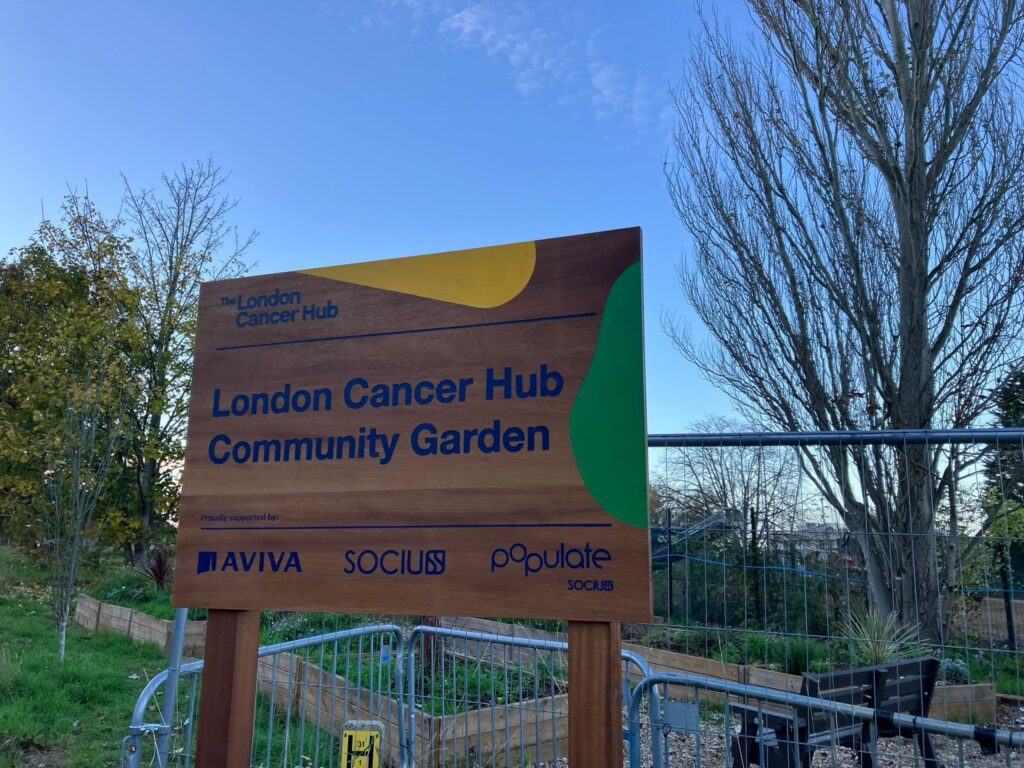
Plans for a £1billion expansion of the London Cancer Hub (LCH) in Sutton have been approved by the borough council, despite concerns over the impact on a century-old allotment, increased traffic in Belmont, and disruption to local streets.
The council and its partners hope the scheme will “solidify” the borough’s status as a centre for cancer research and innovation, but residents have warned that local roads are not equipped to cope with the expected rise in traffic.
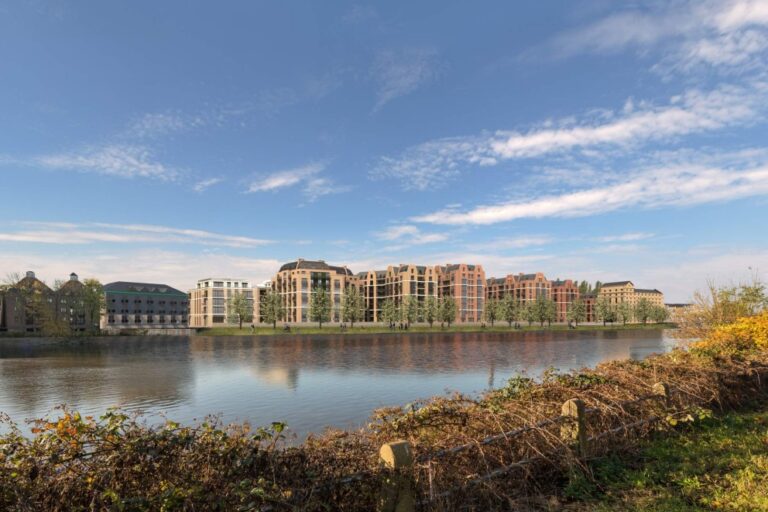
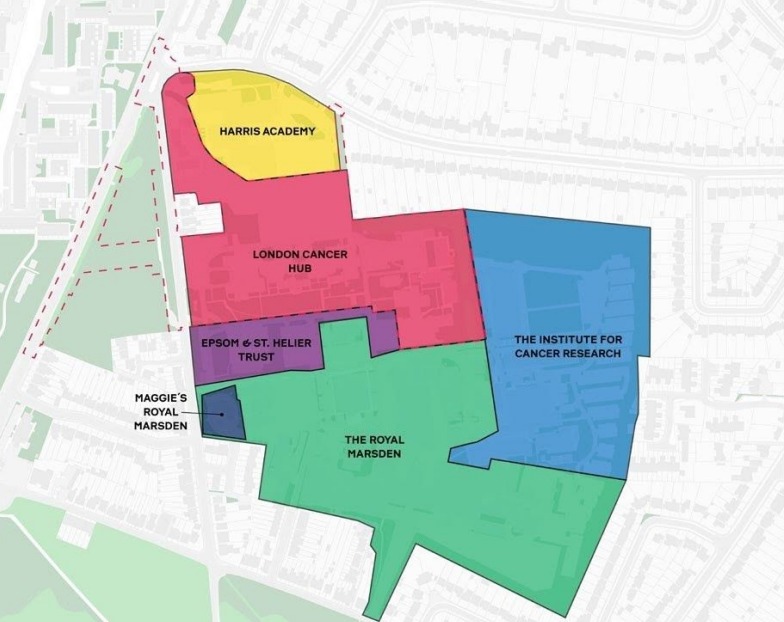
Led by Aviva Capital Partners (ACP) and Socius, the expansion will deliver around 1million square feet of new laboratory and research space across a 12-acre site adjoining The Royal Marsden, Maggie’s Cancer Centre, Epsom and St Helier University Hospitals NHS Trust, the Institute of Cancer Research (ICR), and Harris Academy.
Following the demolition of existing buildings, the approved plans include three new life sciences buildings ranging from four to seven storeys, alongside approximately 220 affordable homes for key workers. The scheme will also place strong emphasis on sustainable design and net-zero features, alongside new public spaces across the site.
Active travel and public transport form a key part of the design with 300 parking spaces across the site and 1,150 cycle parking spaces. The key worker accommodation will be car-free, with parking limited to Blue Badge holders.
According to analysis by Sutton Council, the completed site is expected to support around 13,000 jobs and generate an estimated £1.2 billion in Gross Value Added to the UK economy. The applicants described the site as “a once-in-a-generation opportunity to boost research and economic growth, placing Sutton at the heart of global efforts to improve cancer survival”.
However, despite widespread support for the long-term project, councillors and residents raised a number of practical concerns, with traffic and parking dominating a lengthy and, at times, fiery planning meeting.
The allotment issue
The most contentious aspect of the scheme was the proposed ‘link road’ through the Belmont Allotments, which Sutton Council described as the “most contentious and frequently raised objection” to the development. The road would act as a relief route, connecting Cotswold Road to Brighton Road.
The proposal would require the partial removal of the council-owned allotments, with plot holders relocated to the northern part of the site.
A petition supported by the Belmont Allotment Association (BAA) attracted 120 signatures opposing the plan. Speaking on behalf of the association, Stephen Phillips said the proposals threatened a long-established community and local biodiversity.
“The site is a century old, with a thriving community of tenants from hugely diverse backgrounds,” he said. “It is also a biodiversity hotspot, containing protected species not even found on the nearby common.”
Mr Phillips said the BAA had worked “pragmatically” with developers and put forward alternative options, but warned that retaining the link road in the outline plans still posed a serious risk.
“To separate the allotment would make it geographically unworkable,” he said. “Wildlife populations would plummet and it would no longer function as a community. It would just be areas of dirt.”
Replacement plots are not expected to be available until around 2032 and would require a reserved matters application setting out detailed proposals.
The applicant said: “No works can take place on the relief road until those replacement allotments have been provided.”
The timetable is linked to delivery of the link road itself, which is tied to the future Specialist Emergency Care Hospital (SECH) onsite, now scheduled for no earlier than 2036.
Replacement allotments are intended to offer comparable horticultural quality, including accessible pathways, secure fencing, a sustainable water supply, communal facilities, and dedicated parking.
Traffic, parking and local streets
Traffic and transport formed the other major flashpoint during the meeting. The project’s transport assessment states that a “modal shift” in travel behaviour would be required to accommodate visitors and workers.
The applicant aims to limit private car journeys to no more than 20 per cent of trips. However, many attendees argued this target did not reflect the realities of the site’s location.
Ahead of the meeting, the Belmont and Cheam Residents Association challenged the developer’s traffic forecasts, which suggested traffic on main roads could decrease, describing the assumptions as “improbable”.
Councillors also criticised the predictions, pointing to existing congestion around the Belmont site. Independent Councillor Tim Foster said the arrival of thousands of new workers would result in “an awful lot of cars, bicycles and trips”.
Conservative Councillor Patrick Magnus warned: “This will cause gridlock. When you get gridlock, buses run late, get curtailed, and don’t complete their journeys.”
Questioning the proposed change in travel behaviour, Cllr Foster asked: “Where are you finding this modal shift, when people are queuing for car parking at the Oaks Centre?”
In an impassioned exchange, Conservative Councillor Tony Shields told the applicant: “You are telling us it is all going to be all right when it is not all right. So what are you going to do about it?”
In response, the applicant acknowledged that the site would need to operate “very differently” from its current arrangement.
Residents’ groups also argued that 300 parking spaces for around 3,000 employees were “inadequate” and would inevitably lead to significant overspill parking on nearby streets. The figure was originally capped at 500 but was reduced following intervention from Transport for London (TfL) to align with car-light objectives.
Magnus criticised the emphasis on cycling provision, saying parking spaces were dwarfed by those for “these theoretical cycling Olympiads”. Fellow Conservative councillor David Hicks added: “Expecting so many people to arrive by bicycle is the most ridiculous on Earth.”
Other councillors raised concerns about overspill parking into nearby areas not covered by controlled parking zones.
A key element of the first phase includes a new north–south pedestrian and cycle route linking the LCH to Chiltern Road. Running past Harris Academy, the route is intended to improve access to the northern part of the site and nearby bus stops.
Plans also include a new secondary sixth-form entrance to Harris Academy along the northern boundary.
One councillor described the junction on Chiltern Road as a “nightmare”, adding that the school’s headteacher had raised similar concerns. They said a sixth-form student had previously been hit by a vehicle at the junction and required hospital treatment, arguing it was already operating beyond capacity.
Residents also raised nuisance concerns about a proposed pedestrian and cycle entrance, warning it could encourage antisocial parking, smoking, light pollution, and night-time security issues.
In response, Daniel May, Director of Socius, said: “We are committed to junction improvements, with monitoring in place, and we think that is deliverable.”
Elsewhere, the applicant highlighted plans to increase train services from nearby Belmont station, with services into London set to rise from two to four trains per hour. The increase has been enabled by a £14.1m investment from the government’s Levelling Up Fund.
The applicants have also proposed a shuttle bus to improve access for visitors, although the route has yet to be confirmed.
Criticism was levelled at TfL’s transport assessment, which residents argued failed to account for traffic entering from the Surrey border. Some councillors suggested that up to 50 per cent of LCH traffic could originate from the Banstead end in Surrey.
Speaking for the Belmont and South Cheam Residents Association, Lionel Bell questioned TfL’s approach, saying: “It’s like the Earth ends at Downs Road for them.”
There was a consensus that Sutton Council would need to continue lobbying efforts with TfL for improved public transport provision.
‘Landmark development’
Approval of the outline hybrid planning application allows the project to progress on land use, access, height, and landscaping, but the applicants must return to the council for further approvals as more detailed proposals are developed. Granted on World Cancer Day (February 4), this first-phase approval covers only part of the site.

Credit: London Cancer Hub
Following the approval, Councillor Barry Lewis, Leader of Sutton’s Lib-Dem led council, described the decision as “hugely significant” for the borough and the UK life sciences sector.
“This landmark development will deliver economic growth, health innovations, and tangible benefits for our community, including jobs,” he said. “I’m proud of the council’s work in acquiring the land, securing funding, and finding the right partners to deliver this project.”
Sophie White, Sector Head of Regeneration at Aviva Capital Partners, called the planning consent a “landmark moment” for the scheme. “This development will provide critical science infrastructure for the UK, creating an environment where innovation can flourish and lifesaving research can accelerate,” she said.
Daniel May, of Socius, added: “The LCH is about more than buildings. We are delivering the next phase of investment into a world-class cancer district, creating a catalyst for private investment and long-term growth. By working closely with the ICR, The Royal Marsden, and our partners, we are building a vibrant ecosystem where collaboration drives discovery, supports businesses, attracts investment, and ultimately improves patient outcomes.”