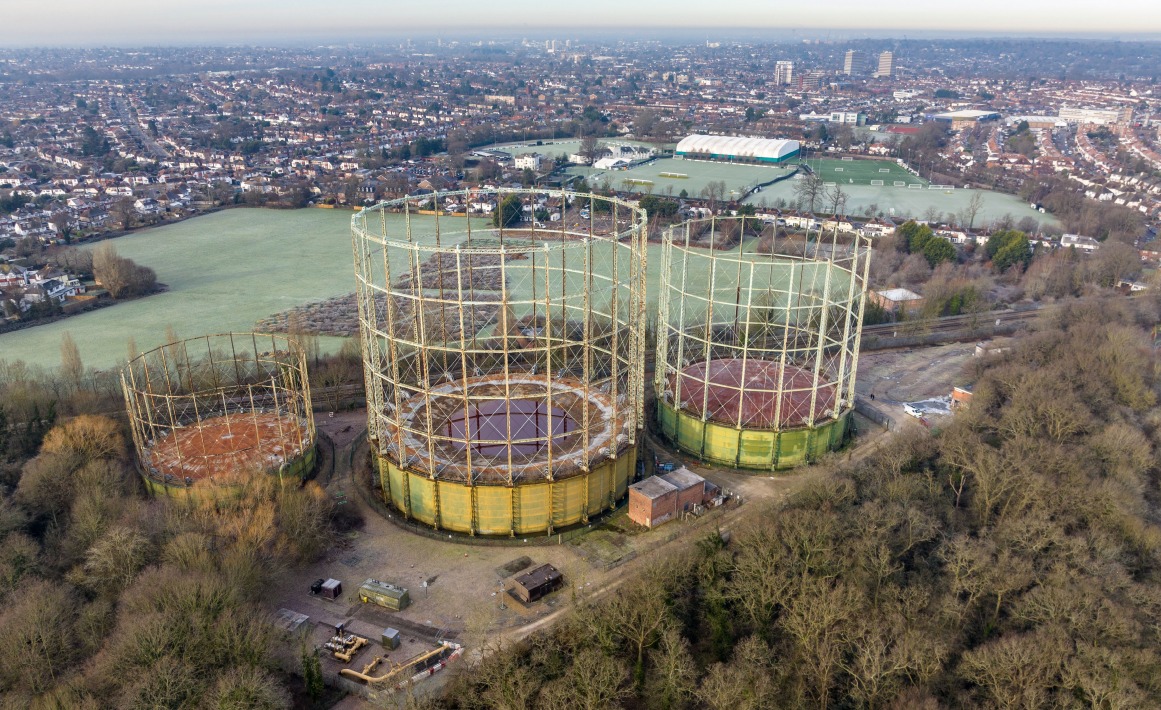
Neighbours of a former South London gasholders say plans to redevelop the site with towers up to 16 storeys tall would cause a “nightmare” for the area. Gas firm SGN and developer Berkeley Homes have submitted plans to demolish three gasholders in Motspur Park for five apartment blocks with 586 homes.
The towers would range from eight to 16 storeys tall and include 175 affordable homes. Berkeley has been working on the plans since 2017 with SGN, which owns the site, and they have submitted a formal application to Kingston and Merton councils to carry out the works.
The proposals have attracted fierce opposition from residents, who said the buildings would be too high, going against local policy, overlook people’s homes and change the character of the area forever. They said the scheme was too dense, given the area’s limited access to public transport and other services, with existing infrastructure unable to cope with such an influx of people.
The site is designated as Metropolitan Open Land (MOL), which means it should be protected from “inappropriate development”.
Neighbours told the Local Democracy Reporting Service (LDRS) they felt approving the scheme would set a dangerous precedent allowing other major developments on protected land. They said it threatened wildlife on the site, including peregrine falcons, bats, newts and slow worms.
Locals also raised concerns about data used to support the scheme in planning documents, as they claimed biodiversity baselines were taken after some trees were cleared from the site in 2022 to help justify it. They felt the plans failed to demonstrate the “very special circumstances” required to build on MOL.
A Berkeley spokesperson told the LDRS the site would be opened up for the community to enjoy for the first time in over a century, which they described as the original purpose of MOL.
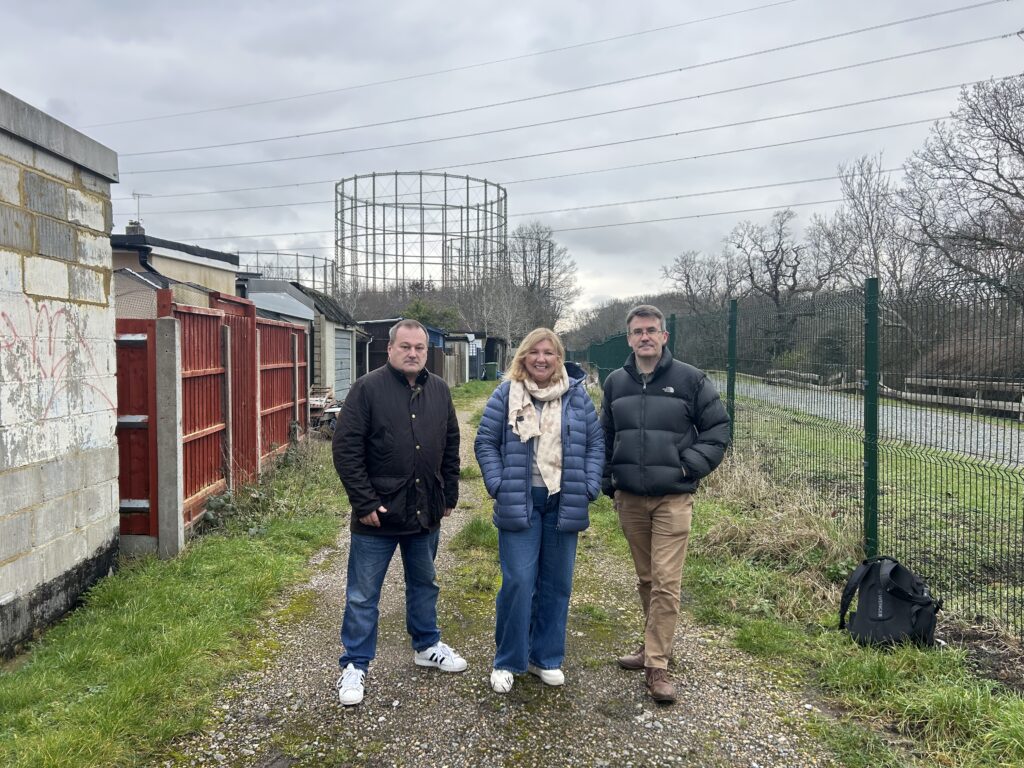
Credit: Charlotte Lillywhite/LDRS
Planning documents argued the site was previously developed brownfield land and that while the scheme would result in a “marked change” to the openness of the MOL, this would not be substantial.
Kirstie Wilkins, who lives next to the site, told the LDRS the area would be put under too much strain by the dense development as it was already congested, particularly along Green Lane, and services were overstretched. She said trains and buses would struggle to accommodate many more residents as they were limited, packed and often delayed.
Kirstie was among locals to raise concerns about the digging up of contaminated land during construction, as she claimed information had not been provided on how this would be managed safely in application documents.
She said: “Obviously there’s going to be a development built there… it’s a prime spot of land because it’s right next to the train station, you’ve got your own access, it just needs to be reduced in size. That’s all we’re asking at this stage.
“The density of the build is just too much for the area. Infrastructure isn’t going to cope, just getting about isn’t going to cope. It’s going to be a nightmare.”
The Berkeley spokesperson told the LDRS the scheme proposed a limited number of car parking spaces to encourage residents to use other transport. They said daily car ownership was no longer essential for many people, who were increasingly seeking more affordable, accessible and sustainable options.
Objectors said the proposed density might suit Central London but not the Zone 4 area, and it was inappropriate to rely so heavily on a single scheme to address Kingston’s housing shortfalls. They said a smaller development should be designed, with further homes distributed across other sites in the borough.
Barry Magee, another neighbour of the site, said the area had the lowest public transport accessibility level (PTAL) rating of zero to one and could not support a development of such scale. “This is basically a Zone 1 [or] 2 development, whacked in the middle of a forest,” he said.
Barry said proposals to provide 89 car parking spaces were unrealistically low for Zone 4, as residents relied on their cars, and would lead to overspill parking on already congested local streets.
The dad said a new road proposed to run behind existing homes to access the development meant people would be able to look directly into their bathrooms and children’s bedrooms, leading to further loss of privacy.
Barry’s letter to Kingston Council opposing the plans also said: “The additional vehicle movements generated by the development will further strain local road capacity, leading to delays and increased safety risks for both drivers and pedestrians.”
It added: “In the planning statement there is significant commentary on the shortfall in housing currently being provided, however this should not mean the one site is overly relied upon to correct this shortfall.”
Terry Paton, who lives nearby, told the LDRS he had spent years speaking to residents about the potential impacts of the development, whose concerns included its scale, congestion, parking pressures and local services’ ability to cope.
He raised concerns about how the application had been handled so far, as he said SGN and Berkeley’s consultation had “asked specific questions to make it difficult to actually give your own views.”
Terry said he was also worried the planning balance would be unfairly tilted in favour of the development as Kingston could not demonstrate a five-year housing supply.
He said: “Whilst I appreciate the need for homes, this whole development is out of character for this suburban area, currently made up of two-storey family homes. The sheer scale and density should be a reason to turn this scheme down, and something more appropriate considered.”
The three gasholders were built in 1924, 1932 and 1954 and were used to store gas for distribution until they were replaced by modern methods of gas storage. They have stood redundant since 2007 and were decommissioned by Ofgem in 2012.
The Berkeley spokesperson said the scheme would deliver 586 new homes, including 175 affordable homes, to help tackle England’s major housing crisis.
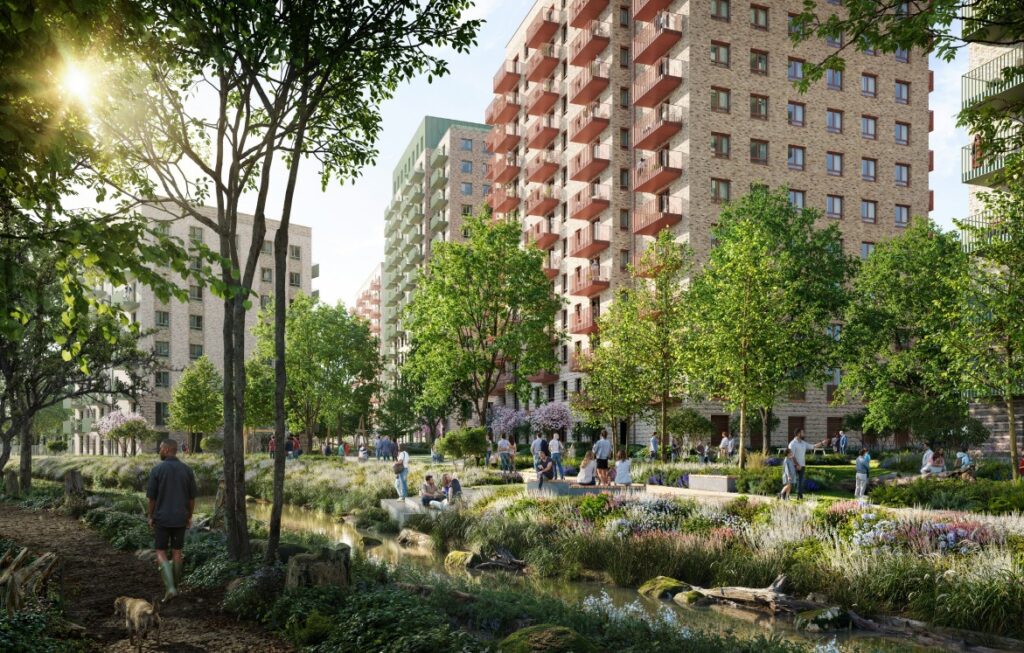
The spokesperson said: “For the first time in over a century, this closed-off site will be opened up for the community to enjoy, which was the original purpose of Metropolitan Open Land. Our regeneration plans will deliver a vibrant mix of market and affordable homes, new job opportunities and welcoming public spaces set within the woodlands.
“At the core of this transformation is a new pedestrian route through the site, reconnecting surrounding neighbourhoods to Motspur Park’s high street and its train station.
“We’re committed to creating a landscape where nature can thrive. We will regrade, replant, and rewild Beverley Brook – restoring it as a vibrant ecological corridor through the site. Over 200 new trees will be planted, contributing to a biodiversity net gain of over 25 per cent, ensuring that the natural environment is not only protected but significantly improved.
“Innovative sustainable urban drainage systems (SuDS), including permeable paving and swales manage rainwater naturally and reducing run off by 50 per cent.”
Sir Joseph Hood Memorial Playing Fields would receive £400,000 investment under the plans, which could include a new multi-use games area, play equipment, trees and woodland trails.
The spokesperson said: “Socioeconomic assessments submitted with the planning application indicate that local schools and GP practices can accommodate the needs of the development at present. Regardless, significant CIL & Section 106 contributions will also be available to upgrade local infrastructure services.”
They added: “Contributions to the boroughs will improve sustainable travel infrastructure to encourage further non-car travel by new residents. To support this approach, a comprehensive package of sustainable transport measures is proposed as part of the scheme – improved accessibility to Motspur Park station, safe and secure cycle parking, exploring expanding e-bike hire within and through the site and the provision of vouchers to residents of the proposed development to support bus and/or cycle use, removing barriers to accessing sustainable transport options.”
Identical planning applications have been submitted to Kingston and Merton councils as the site spans both boroughs, although most of it sits in Kingston. People can still comment on the plans on Kingston’s website.
The councils will each make a decision on the application in due course.