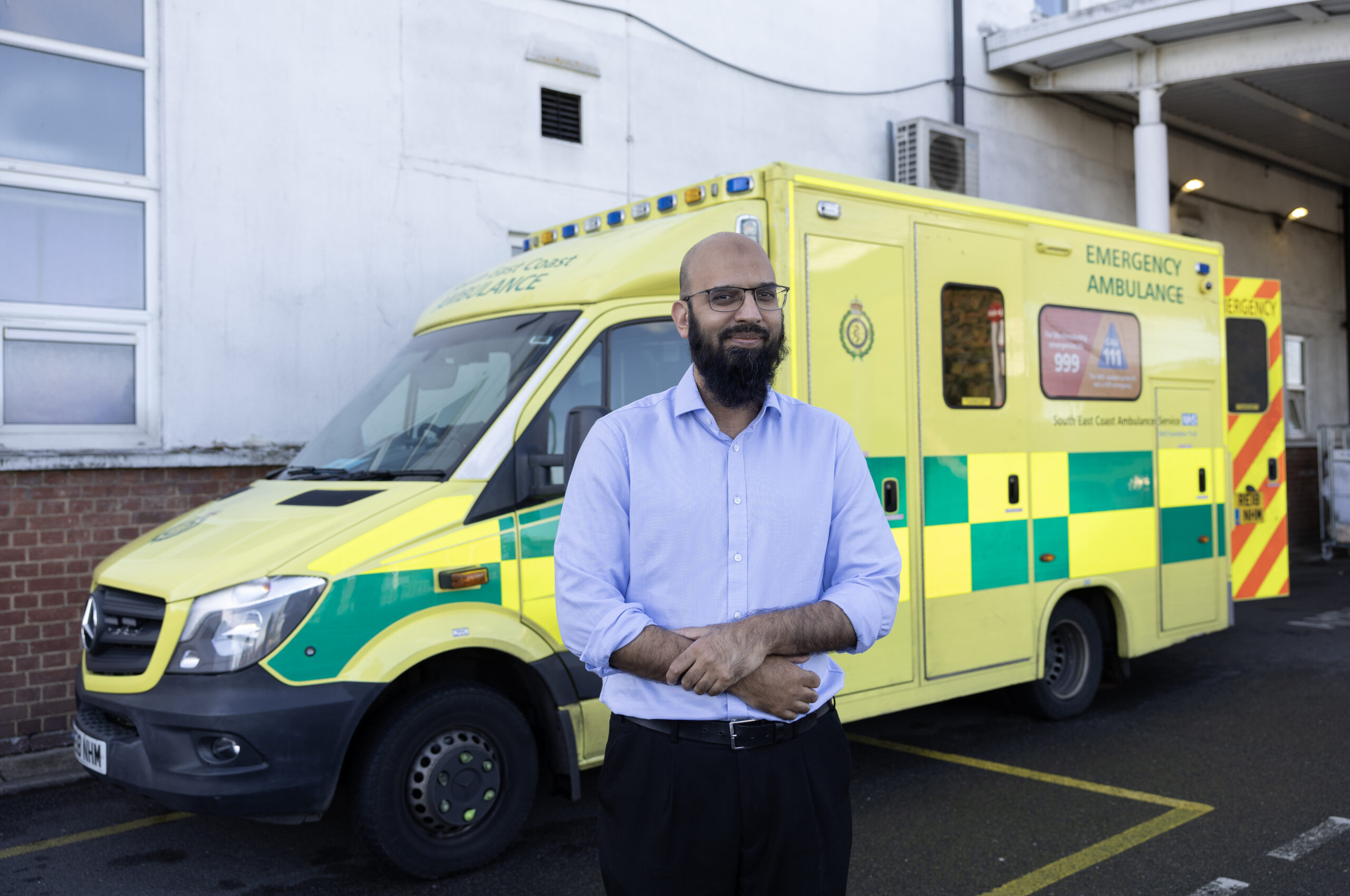
The head of St Helier’s A&E has warned the hospital cannot currently guarantee patients’ privacy and dignity on the ward, as it prepares for a much-anticipated £57m rebuild.
Dr Amir Hassan told the Local Democracy Reporting Service (LDRS) that cramped conditions at St Helier’s A&E often force patients to undergo sensitive treatment in corridors, describing the staff experience of working in the ward as “horrible”.
The South London hospital hopes a planned £57m rebuild of the ageing department, due to begin in 2027, will reduce overcrowding and improve patient care.
“We can’t currently provide an experience that I would want for myself and my family,” Dr Hassan told the LDRS.
“We don’t have space to move patients to cubicles. If I come in and I have diarrhoea and vomiting for example, ideally you should have a separate cubicle with a toilet.
“That is for your privacy and dignity, but at the moment we can’t promise you that. Although we have screens up to give privacy in a corridor, it is not the same as having your assessment and treatment done in a cubicle.”
He said the current lack of privacy affects a wide range of patients, but raised particular concerns about the impact on vulnerable people, cancer patients and those with mental health conditions.
Dr Hassan, who has worked at the hospital since 2008, says the A&E department’s layout is now limiting staff’s ability to provide patients with the comfortable and dignified they aim to provide.
“We have quite a pocketed A&E department, so you have little areas you can put patients into for treatment and rescue care,” he told the LDRS.
“What it should be is that when you come in you get seen, triaged quickly, processed and put into a cubicle and assessed in proper dignity. However, patients don’t float through the department, and we don’t have clear sight of patients.”
The increase in the number of patients coming through the department’s doors has only increased pressure on the service. “The department is crowded and overwhelmed,” he said.
A damning Care Quality Commission report, published earlier this year, revealed how the facility was treating up to 250 patients a day, despite having been designed to accommodate just 24. The department records around 90,000 A&E attendances each year, according to recent figures.
Acknowledging the incoming investment in the department, Dr Hassan said: “With the new build we will be trying to avoid that overcrowding by setting up separate areas where we can put patients in.”
The £57m NHS rebuild
The £57m A&E redevelopment, announced this summer, will deliver a larger, redesigned department with upgraded clinical facilities, a new Urgent Treatment Centre and expanded Same Day Emergency Care services to help reduce ‘avoidable admissions’ and overnight stays.
The NHS London-funded project is expected to begin construction in spring 2027.
Following the announcement in June, Dr Hassan told the BBC that the funding was a “significant and very welcome investment” in the hospital.
However, in our interview, he told the LDRS how the rebuild could face its own challenges.
“We have looked at the amount of floor space we need to ensure we have the services separated properly,” he said.
“When you look at it from an NHS perspective, and you are trying to do a lot of stuff and move people around to create capacity, it is not that much money and it won’t go very far.”
This comes as Epsom and St Helier University Hospitals NHS Trust told the LDRS that it has spent £60m over the past three years repairing the ageing St Helier site – parts of which date back to 1941. The work has included lift maintenance, pipe repairs and leak repairs.
The A&E rebuild team has also visited other emergency departments, including in Bournemouth and Croydon, ahead of construction to identify successes that could be replicated at St Helier.
“One of the key things we took from that was that it’s great to have a brand new shiny A&E department but what you want to do is sort out the processes and the flow behind it first,” Dr Hassan told the LDRS.
He added: “We definitely need this change as soon as possible because when winter comes you have a lot more patients coming in with chest infections.
“So if we get overwhelmed the place you are going to feel it the most is the emergency department, because patients don’t have anywhere else to go to.”
The hospital also confirmed that preparatory work to upgrade water and electricity systems has taken place ahead of the main construction phase next year.
Despite the planned A&E rebuild, St Helier is still awaiting a wider package of hospital upgrades originally promised by 2030 under the Government’s New Hospital Programme. In January, the Government pushed funding for the upgrades back to 2032-34, citing the ‘unaffordability’ of the original plans.
Last month, the LDRS revealed how cracks and broken lifts across the hospital had restricted bed capacity and disrupted patient care. Meanwhile, problems with the hospital’s pre-war water pipes could soon force the full or partial closure of the women’s health ward, potentially affecting thousands of patients in the coming months.
What about staff experiences?
Elsewhere, Dr Hassan hopes the long-awaited rebuild will improve the experiences of staff working on the ward, which he currently described as “horrible”.
“We are all built to work in a normal environment and there is a moral fatigue around treating patients in corridors,” he said. “It is not a good thing and it burns out your staff.
“I work one day a week in the hospital, and even after that one day I will go home after my shift and fall asleep because I’m knackered.”
However, the doctor was quick to praise St Helier’s A&E staff for their work ethic in spite of the conditions.
“The culture I have found at St Helier is one that I have not found in any other hospital I have worked at,” he said. “It is really friendly and people are welcoming and care about patients.”
A spokesperson for the Trust said: “We’re incredibly grateful to our colleagues who go above and beyond every day to provide safe and compassionate care, despite the challenges of our ageing buildings.
“Our cramped Emergency Department means we can’t always treat patients in the way we would like – we are pleased that our extension will be completed very soon, to help us care for more patients in better conditions and further our ambition of eliminating corridor care.”