There’s a word used in the depiction of Indian art and experience, rasa, which B. N. Goswamy explains has multiple, multifaceted meanings: it is at once the essential ‘juice’ or ‘flavour’ of a thing, the ‘relish’ it provides the viewer and the very ‘sentiment’ it evokes. While we may associate the region and its makers with heat and vibrancy, Tim Renshaw’s recent body of gouaches, however cool-toned and non-committally constructed, meet almost every rasa definition.
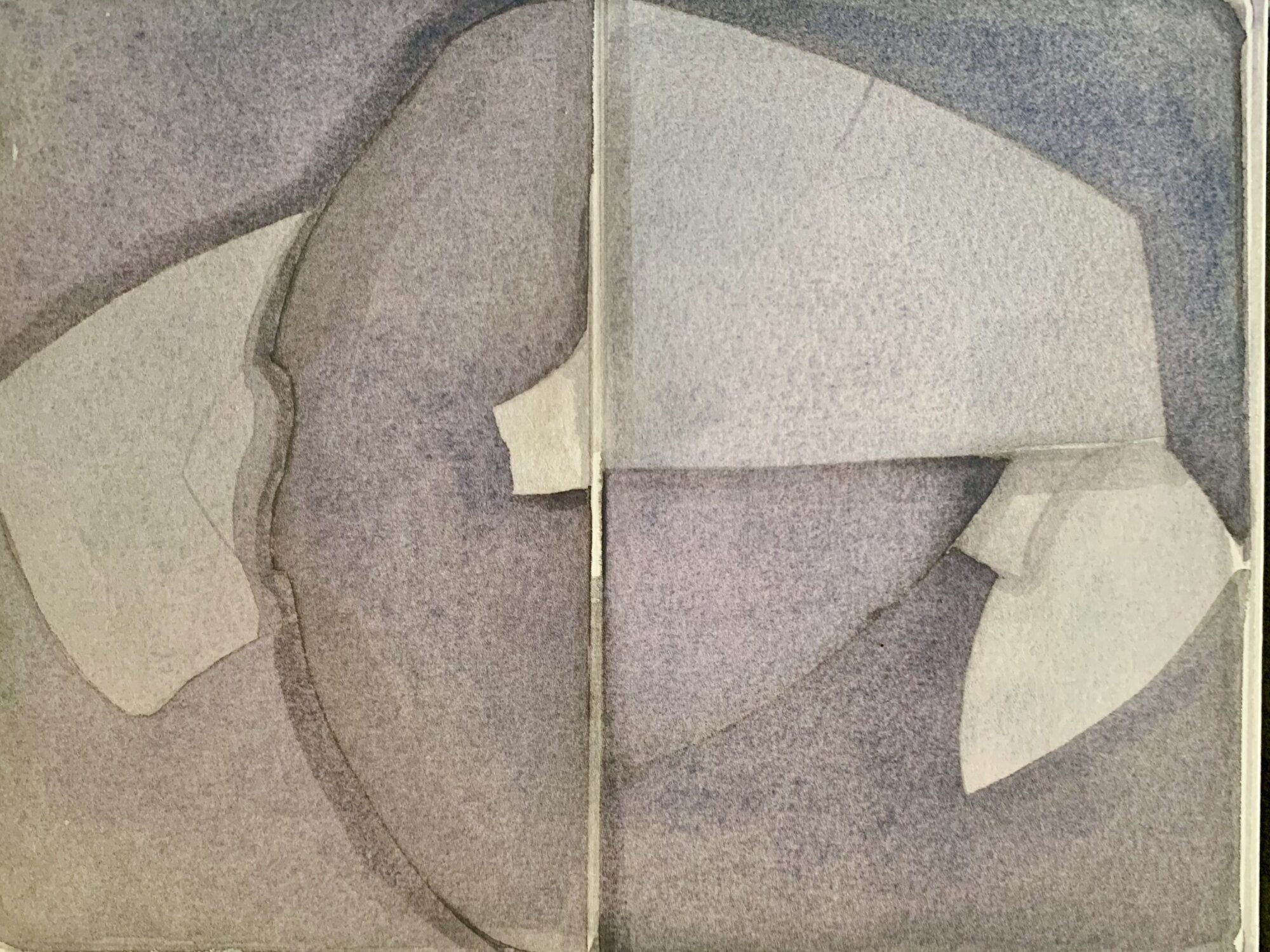
Created during a Shelagh Cluett Trust-funded residency in Varanasi, India, earlier in the year, this expansive paper ‘deck’ of delights offers new insights into Renshaw’s making and research processes; his relationship with architecture, Modernist motifs and books as repositories of knowledge. Each ‘hand’ offers glimpses – on a sliding scale between figuration and abstraction – of the objects and interiors of the library at the Alice Boner Institute (ABI).
First shown in and amongst the ABI’s book collection, these works were literally pages among pages – notes in a place of knowledge. Now, hung on the gallery wall, they hold a different weight. No longer just a response to a place, the works become a conversation with the artist’s own making history, allowing other qualities in the paintings to be given their due.
As a series, it marks a departure in medium but a continuation of the rigorous formal inquiry that defines his practice. But still, the shift from layered oil on aluminium to gouache on uniform sheets of paper allows for an immediacy of response that stands in contrast to Renshaw paintings we have ‘known’. These works were not drawn from art historical and other images in the studio, but from life itself. What if, finally, we’ve been given access to the ‘leaves’, the trapped surfaces implied by the almost trompe l’oeil edges of his works in oil?
Not much bigger than a tarot deck, this whole exhibition might fit in a shoe box. While small and identical in scale, possibly for reasons necessitated by travel and Renshaw’s love of (at least some sense of) a system, traces of miniaturist traditions can be found amongst the curves, contours and gauze-like manifestation of light that fill each swatch. In Goswamy’s definitive book, The Spirit of Indian Painting, he talks about the effort required from the viewer to truly ‘receive’ a work, enter its layered world of meaning. It is in this quiet contemplation, invited by Renshaw’s thoughtful practice, that we find the truest flavour of these paintings – savouring their essence one delicate, resonant moment at a time.
Coleman Project Space, 94 Webster Road, Bermondsey, London, SE16 4DF. 30 August -14 September. Tim Renshaw in conversation with Cath Ferguson at 3pm.
Times: Fri Sat Sun 12-6pm