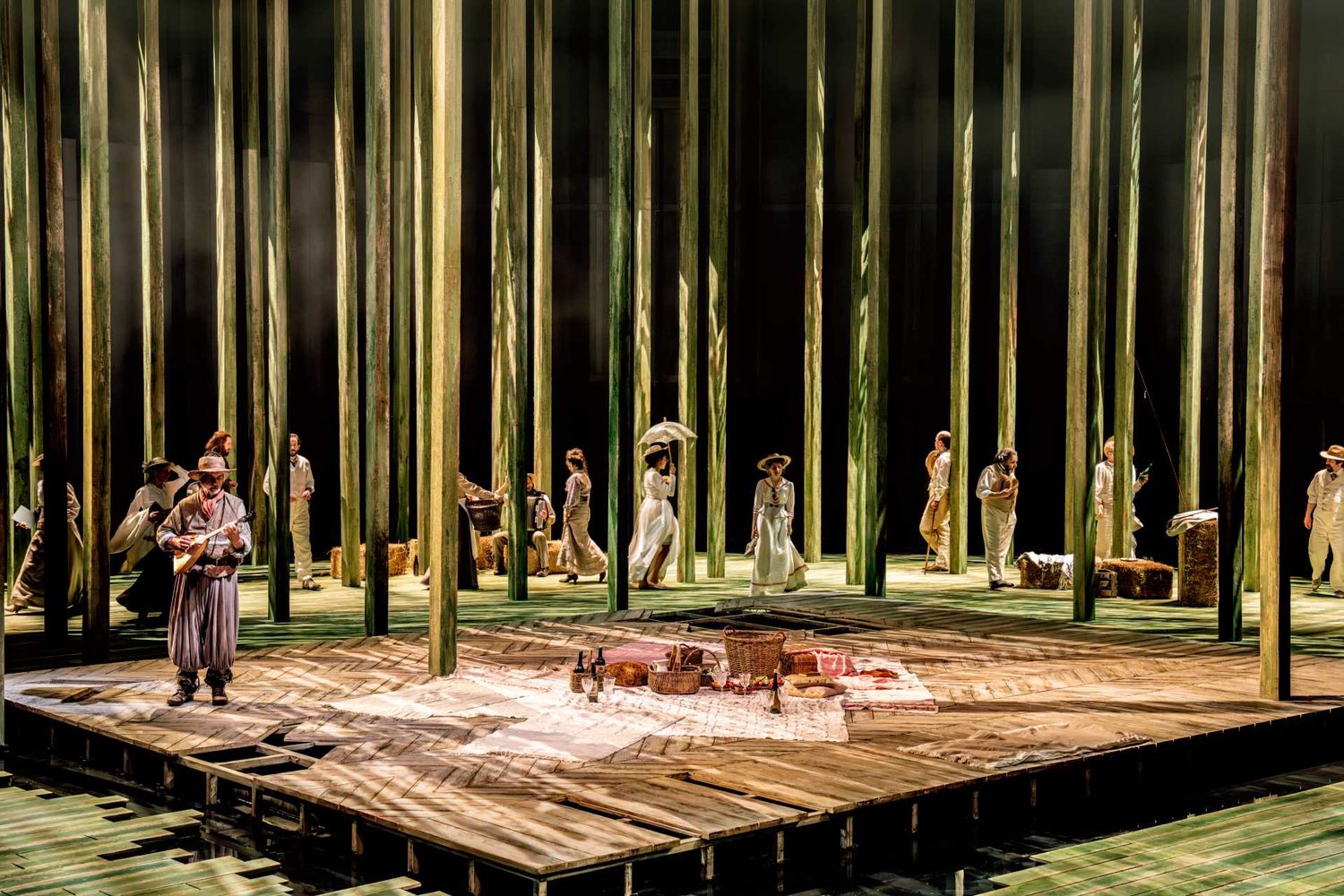
We are in early 20th Century Russia, a time when comfortably off city-dwellers are flocking to the countryside to rustic ‘dachas’ that they rent from locals, operating an open-house policy that sees their friends breeze in and breeze out, writes Eleanor Thorn.
Summer has arrived and Sergei (Paul Ready) and Varya (Sophie Rundle), the host “dachniki” or ‘dachniks’ as per the original title of the play, are expecting friends and relations. An ominous single gunshot sets the play in motion like a starter-gun. A couple of raggedly clothed peasants patrol the property and serve as a visual reminder of the chasm between haves and have-nots.
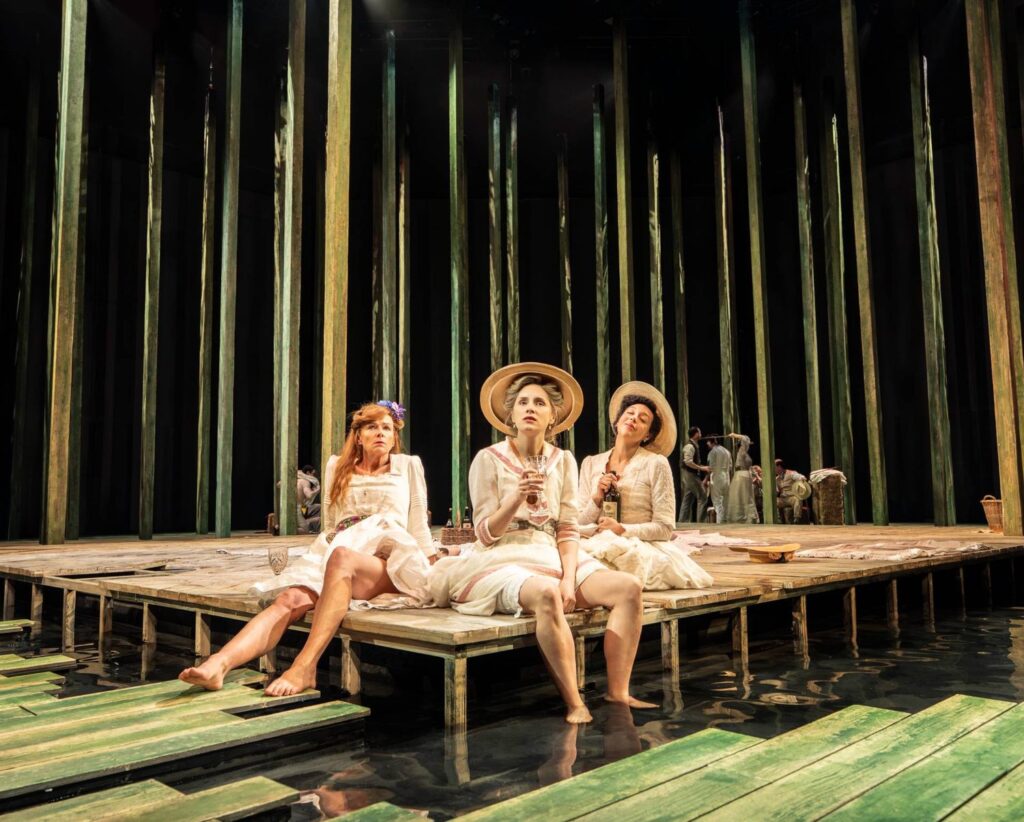
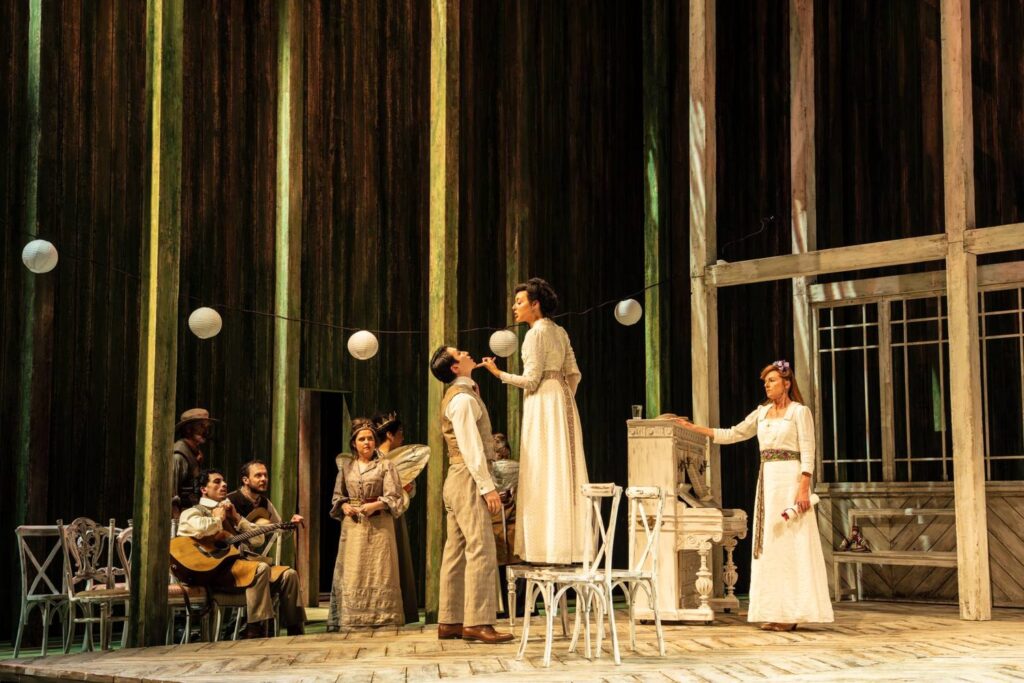
Varya (Sophie Rundle) is the queen of nihilism. Wan, depressed, fatalistic, unable to pinpoint the exact cause of her disquiet, she expresses what most of the other characters, of whom there are many, are also feeling. Her expressionless constant calm ends up annoying others, but before we get to that point, we are amused by this gathering of people grappling with the “pointlessness of life”. Varya’s brother, mad, unkempt Vlass (Alex Lawther), is small in stature and great in eccentricity, the star of the show. A poet (not the only one amongst them), he alone manages to step out of his inertia, declare love, and successfully woo older Maria Lvovna (Justine Mitchell), who goes through convulsions of guilt before giving in, quite awkwardly and delightfully. Less loveable are the other men, the show-offs and the pompous, the self-pitying and the misogynistic. Sergei is not the only one to reveal a darker, aggressive side. “Sunny boredom” is “unbearable”, despite such pastimes as play-acting, fishing, and chess-playing.
Weird whistling noises provide scene changes, and it is not until Olga (Gwyneth Keyworth) arrives complaining of the “whistling of the watchmen” that we understand what it is.
Upright beams provide a striking, minimal structure, suggesting dacha walls (set design by Peter McKintosh). Yet more beams stand tall in the second half, becoming a forest through which a stream, front-of-stage, runs. The sweltering heat and airlessness are marvellously depicted. Alcohol is aflow. Relations seem like they will rejuvenate only to unravel and combust, kick-started by Suslov (Arthur Hughes)’ fury at losing his inheritance. The women walk out, turning their backs on these “living dead”. First thunder, then a sudden closing round of gunshots tell of more ills to come.
Playwright Gorky’s beginnings, more lowly than those of Chekhov, who died before this premiered, allowed him a more caustic criticism of the privileged, which meant it hit hard. The National’s audience is positively sedate by comparison to the uproarious reactions it will have met with that first year, when Russia was edging already towards Revolution. Back then, the more conservative, well-to-do were appalled, heckling, whilst the younger crowd cheered. We are closer to being inert, complicit even, echoing such statements as “life is getting worse and worse”. Our sense of humour is tickled in a quieter way, neither heckling nor cheering, less entwined than its original audiences. This means that although this adaptation (Nina and Moses Raine) is worded to be more relevant to us, hitting as hard as it did then is a tall order.
Olivier Theatre, National Theatre, South Bank, London, SE1 9PX until 29th April.
Booking and full details: https://www.nationaltheatre.org.uk/