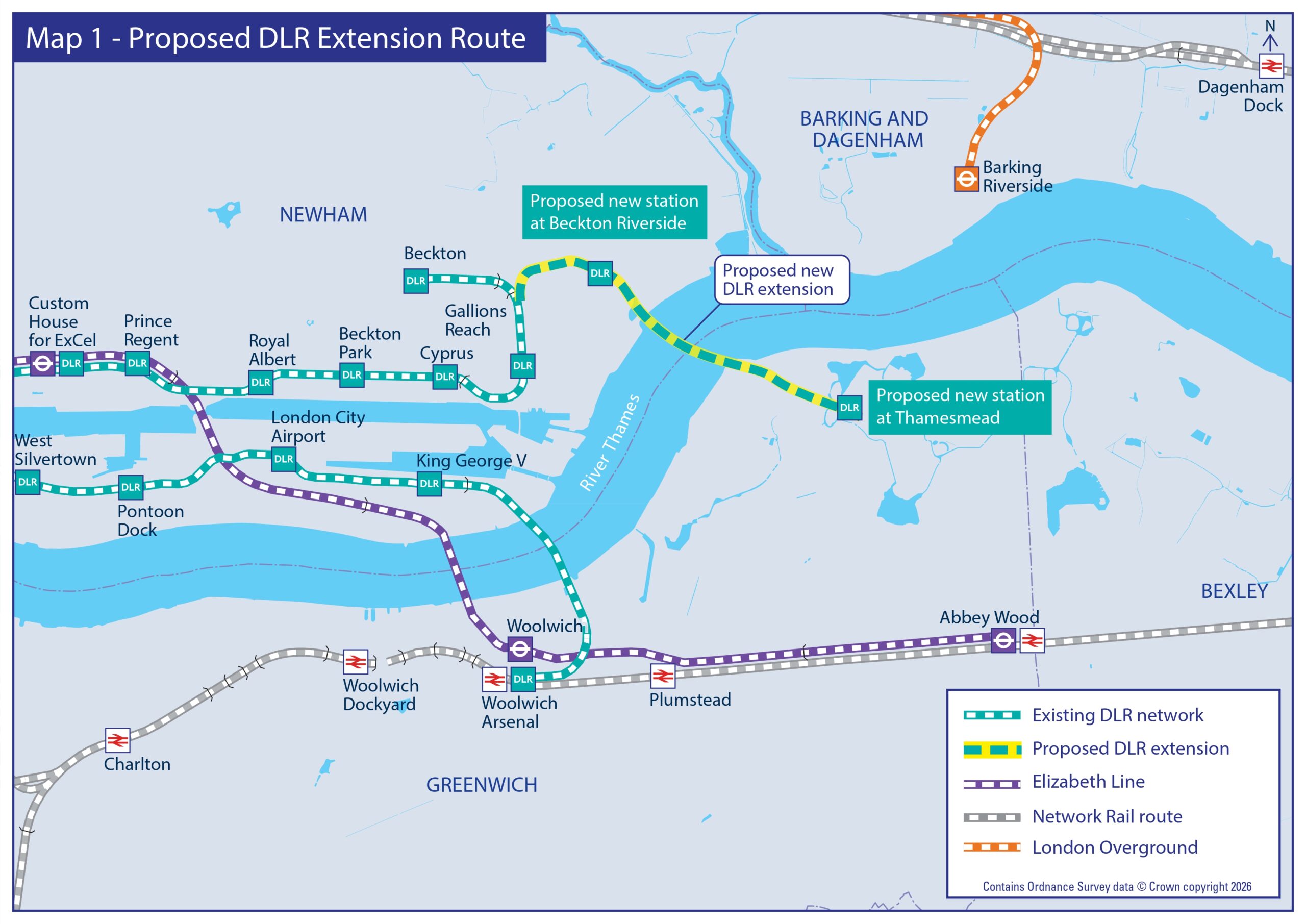
Transport for London has revealed new details on its proposed DLR extension across the River Thames to Thamesmead.
London’s public transport operator has launched a consultation and is asking the capital’s residents to give feedback on its DLR extension proposals.
The consultation opened on June 5 and closes on July 16. Below are the key details from TfL’s plans.
What will the extension look like?
TfL’s proposed DLR extension would branch off from the existing DLR line after Gallions Reach, travelling through the Beckton Riverside area on a viaduct before descending to a new ground-level station in Beckton Riverside to the south of Armada Way.
From here the track would descend underground into a tunnel to cross under the River Thames to continue the journey towards Thamesmead.
The track would come out of the tunnel at Thamesmead onto a viaduct to pass over the Twin Tumps and Thamesmere before terminating at an elevated station in Thamesmead town centre on the current site of Cannon Retail Park.
Why does TfL want to build the DLR extension?
TfL says that both Beckton Riverside and Thamesmead lack direct rail services. It said this lack of direct public transport has “limited local access to jobs, education, and services for decades”.
As both areas are being targeted to deliver thousands of new homes over the coming years, better transport links will be vital in connecting these new hubs to the rest of London. TfL hopes the DLR extension will support the construction of up to 30,000 new homes and create up to 10,000 jobs.
The extension will also cut journey times. Travelling to the City would drop from about an hour to 35–40 minutes, with trains initially running every 8–10 minutes.
It would also strengthen East London’s cross-river links which are sorely lacking, as well as supporting a modal shift from cars to a more sustainable transport mode.
How would the extension be built?
TfL has said it would take five years to build the DLR extension, with work taking place in Beckton Riverside, Thamesmead and beneath the River Thames.
In Beckton, the Beckton Riverside station would be built alongside a new junction with the existing DLR and new viaducts. This is also where the tunnel boring machine would be launched from.
Two 1.5km tunnels would be excavated beneath the Thames which would provide the river-crossing for the new railway. South of the river in Thamesmead, a shaft will be built where the tunnel boring machine will arrive alongside new viaduct structures and the new Thamesmead station.
Once the machine makes its way south of the river, it will be turned around and sent back below the Thames to make the second of the two tunnels.
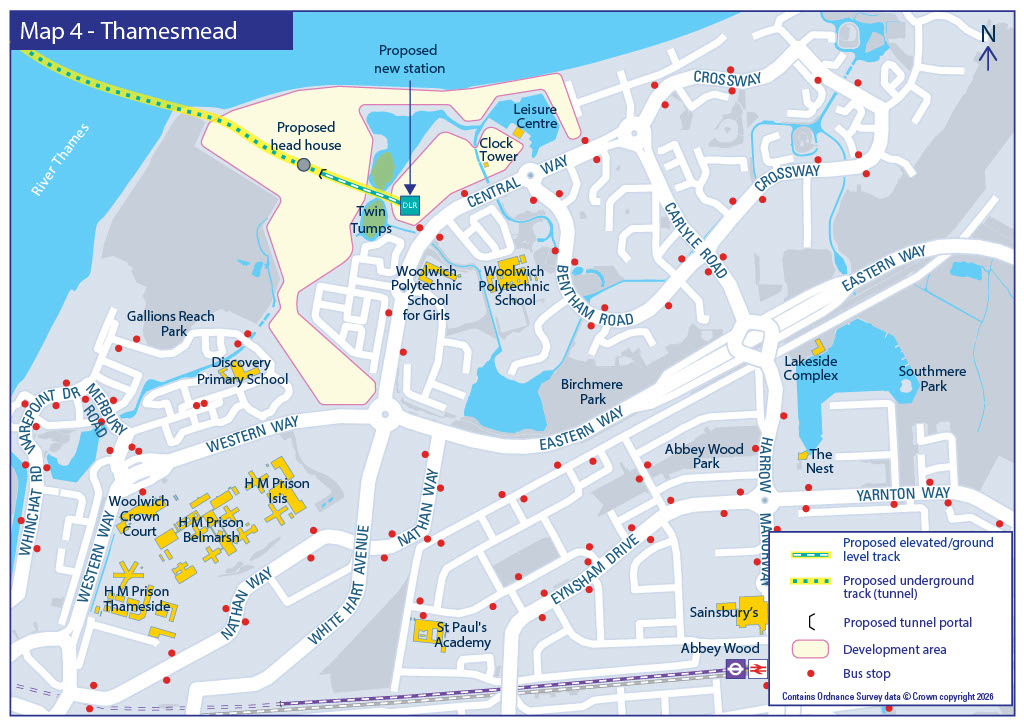
TfL would need four worksites in Beckton Riverside to facilitate all of the works, all of which would be located between the former Beckton Gas Works and the Beckton DLR depot and Armada Way. There would also be a sizable site between Armada Way and the river.
In Thamesmead there will be two worksites, one in Gallions Reach Park and another on land currently taken up by Cannon Retail Park. The retail park would be demolished to make way for the Thamesmead DLR station.
What impact will the work have on existing DLR services?
Throughout most of construction, TfL predicts the DLR network would not be affected as most of the work needed takes place away from the current Beckton branch.
When the DLR will be affected is when the newly built railway is connected to the existing network. TfL said this can only be safely completed when no trains are running, so there would be limited closures over a series of weekends or during a longer planned period to facilitate this.
How much will the work cost?
TfL has estimated that the entire project could cost around £1.5billion. As the plans are yet to be finalised, this total could vary subject to further design work, surveys and investigations and confirming how the extension could be built.
As part of the Autumn Budget in November 2025, the Government announced their commitment to the scheme, including financial support to help TfL deliver it. This includes a mechanism that enables the Mayor of London to raise funds through borrowing to pay for the extension’s construction.
This borrowing will be repaid over time using direct funding from the Government and new funding unlocked by the scheme, such as the fares revenue from ridership on the extended portion of the DLR route.
According to TfL, this funding model builds on the approach successfully implemented on previous projects such as Crossrail (Elizabeth line) and the Northern line extension.
What are the next steps?
Once TfL concludes its consultation, it will start to finalise its proposals and then get ready to submit a Transport and Works Act Order (TWAO) application to the Secretary of State for Transport to make a decision on the scheme.
A TWAO can authorise the construction, operation and maintenance of new transport infrastructure. It can also provide compulsory purchase powers for acquiring property interests and rights.
The land and property needed for the extension would be acquired either voluntarily or by compulsory purchase powers granted through a TWAO. TfL is seeking to reach an agreement with landowners to acquire land needed for the scheme in advance of the TWAO application.
TfL is not planning on demolishing any homes to build the extension.
A TWAO application could also be accompanied by a request to the Secretary of State for Transport to give a direction for deemed planning permission for the works to be authorised by a TWAO, meaning that planning permission could be granted by the Government rather than the local planning authority, in this case Greenwich and Newham councils.
Subject to a funding agreement with the Government and the necessary TWAO approval, construction on the DLR extension could begin by 2029 with the extension and new stations at Beckton Riverside and Thamesmead potentially opening in the early 2030s.
What will the future of the DLR look like?
When the extension opens, TfL initially expects to run trains every 8–10 minutes to and from Thamesmead (via Beckton Riverside) and trains every 8–10 minutes to and from Beckton. Together, this would mean a train every 4–5 minutes between Canning Town and Gallions Reach.
TfL will need more trains to deliver this level of service. The destination of trains from Thamesmead and Beckton Riverside beyond Canning Town will be confirmed closer to the extension opening and TfL said it will be informed by wider network and customer needs.
TfL said it is currently focused on extending the DLR to just Thamesmead, and any further extension, for example into Bexley, would need more detailed development on the best route and destination and be subject to a new funding agreement.
To read more about TfL’s DLR extension proposal and to contribute to the consultation visit the consultation website.