Exhibition and new film on days leading up to D-Day
The daily news is full of war and senseless killing somewhere in the world, and it never seems like it will ever stop. Perhaps all schoolchildren should learn about the futility of war so that they might become the generation who finally puts an end to it, writes Michael Holland.
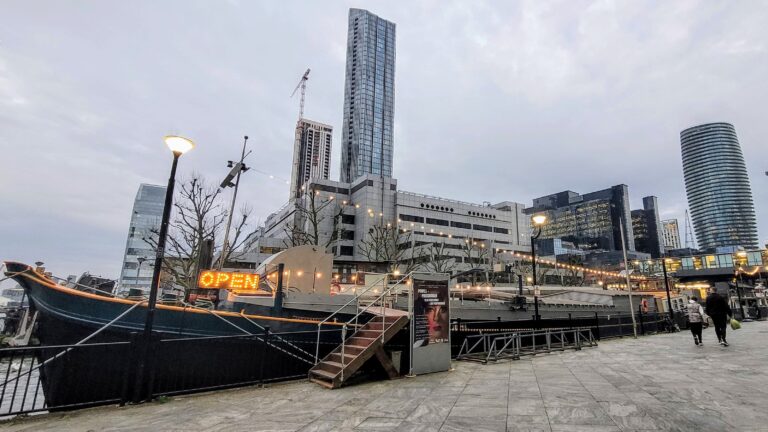
I visited HMS Belfast today because it is always evolving; there is always something different to see, along with the old favourites.
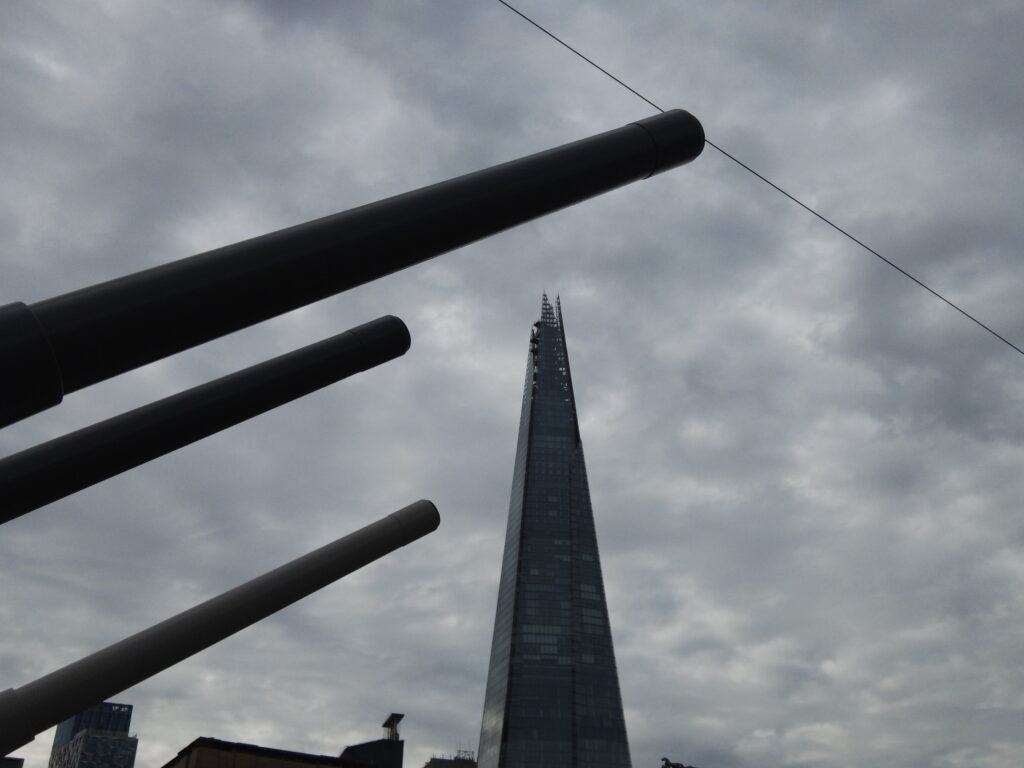
I started off in the gun turret, listening to the commentary and the sounds of big cannons firing, men shouting; you could feel the heat, the tension, the adrenaline rushing through your body and the fear of dying. I imagined it filled with sweating men on missions to kill or be killed. Drilled to the nth degree in routine, able to reload the guns in under eight seconds. You can hear them on the soundtrack: ‘One, 1000, two, 1000, three, 1000…Fire!’
I heard how HMS Belfast was integral to finishing off the German battleship, Scharnhorst, when it tried to intercept a convoy the Belfast was protecting. The Belfast was feared.
I took a turn around the deck and looked at the changes made on both sides of the Thames; many buildings replacing those destroyed by Hitler’s Luftwaffe. The people killed can never be replaced.
I went down to the boiler room and the engine room; a descent via narrow stairs to cramped spaces that never had the aircon the Belfast has in some of its areas today. The engine room was a mass of gauges and pipes, pumps and switches, trip hazards galore. This was hell in a hull.
On another deck, I got to steer the ship, taking my orders from the captain who shouted them down a tube; spinning the wheel this way and that as the numbers came through. Driving blind, hoping the officer above had a better view.
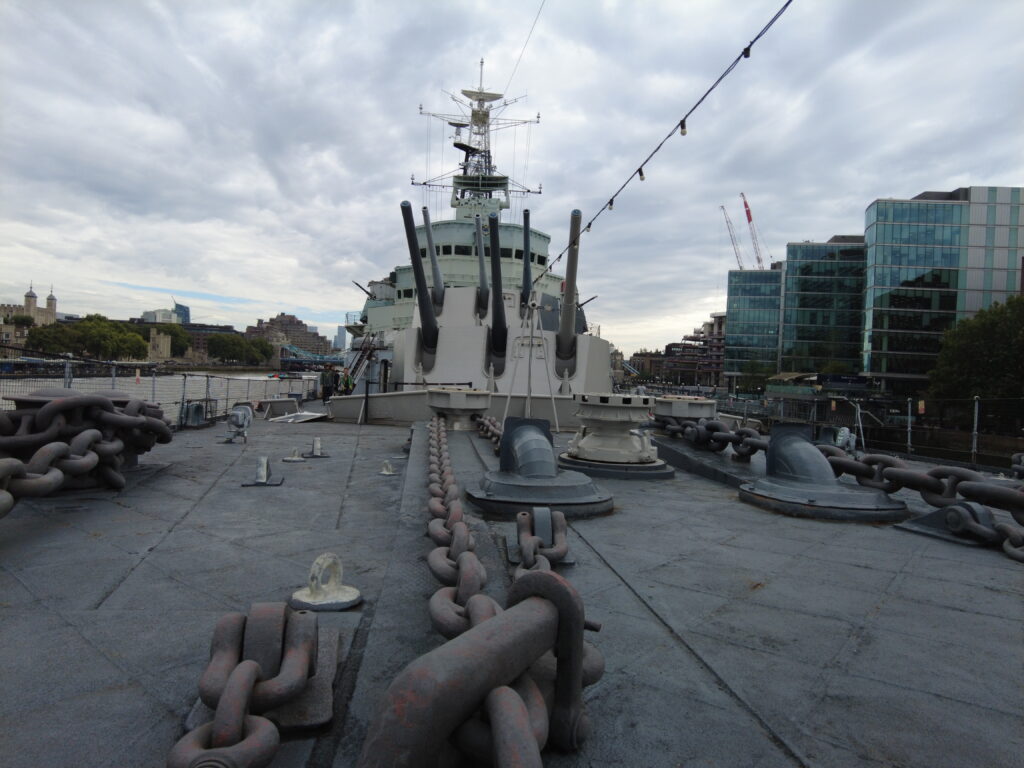
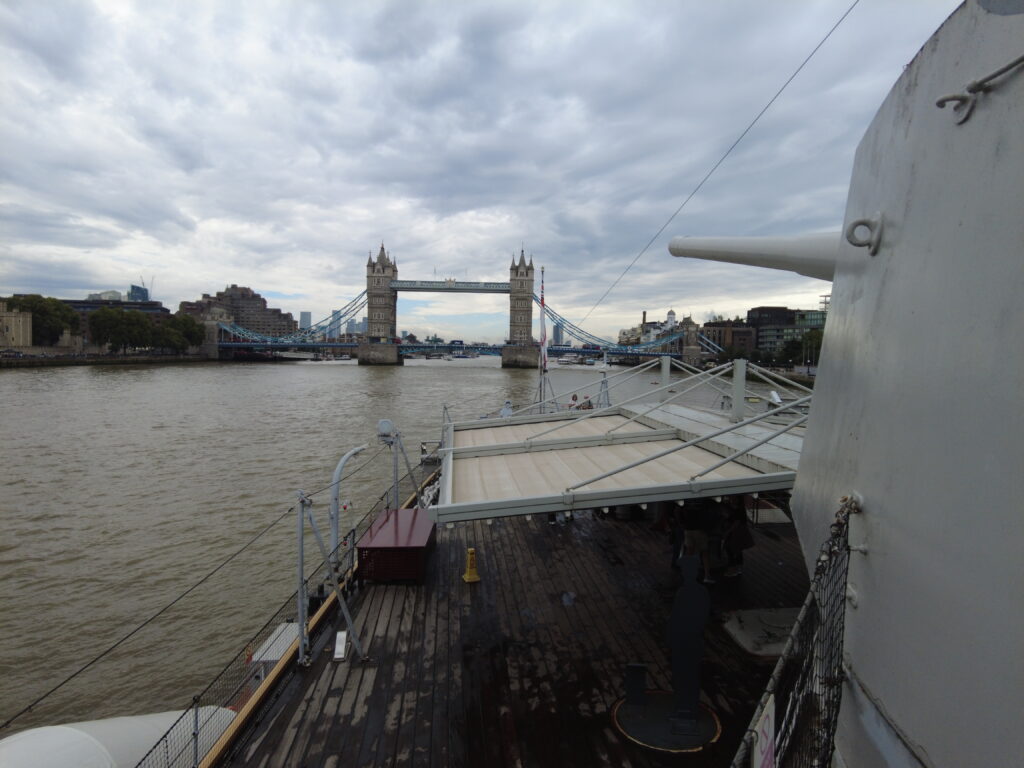
I listened to how the Belfast pulverised the Normandy coastline at 5.30am on June 6th, 1944, D-Day, hoping to clear away the Germans before the Allies ran off the landing ships. They ran into machine gun fire, many not even reaching the beach before they fell under the hail of bullets.
I visited the sick bay. You wouldn’t want to go there for real.
Next up was the war in Korea. Governments fighting each other, but not government officials doing the dying.
Yes, there were some peaceful post-war missions, but it’s the heroics that make the headlines, and most of the heroes died in action.
In the NAAFI café, I tried to focus on the fern leaf in the froth of my latte, but struggled to shake the thoughts of wasted lives from my mind. I thought about striking up a conversation with the tourist family I shared a table with, but they seemed as subdued as I was. Everyone did. Even though we were on a ship that survived much, we were surrounded by an aura of death.
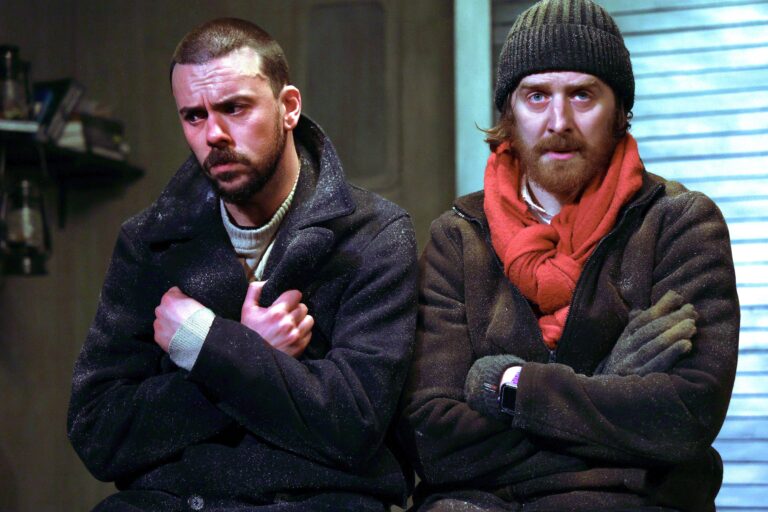
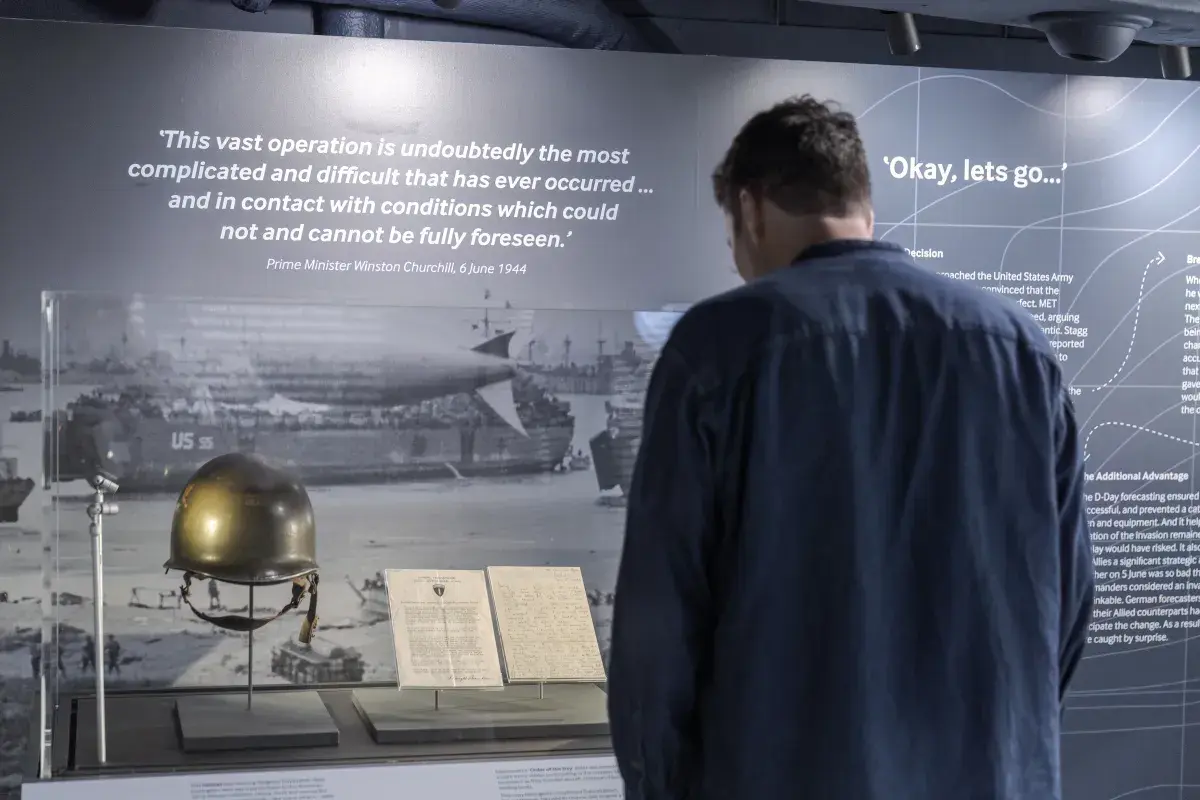
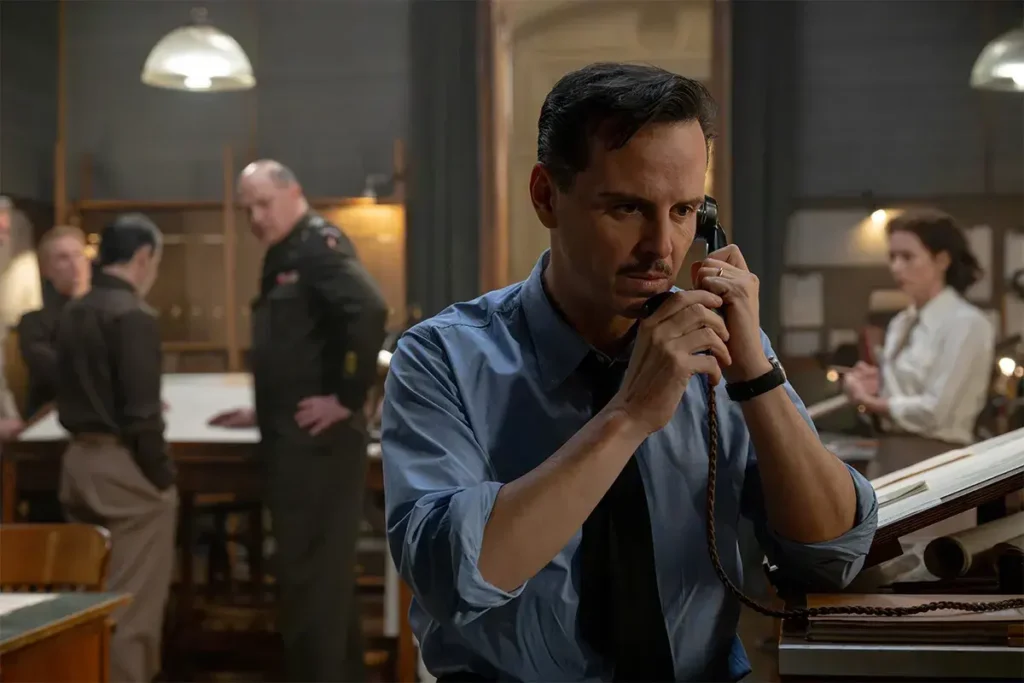
There was one last thing I had to see, and it was Pressure: The D-Day Decision, the exhibition that brought to life the negotiations, preparations, and planning between the Allies for the three days leading up to the big push to take back Europe and win the war, and coincides with the release of the film, Pressure, starring Andrew Scott, Brendan Fraser, Kerry Condon and Damian Lewis.
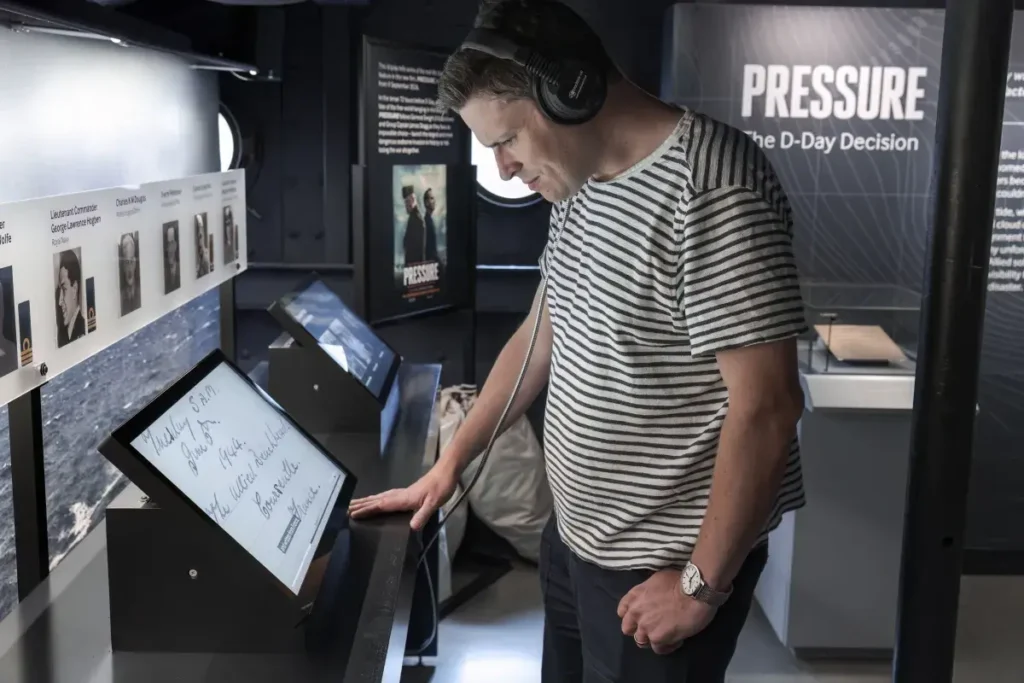
Inside the temporary exhibition on a scrap of paper, General Montgomery’s plan was to keep it simple, so he made a few notes on a page that he presented to his top commanders.
James Stagg’s diary spoke of the differing opinions between the commanders leading up to D-Day. Stagg was the meteorologist who advised General Eisenhower to cancel the invasion for a day. ‘It is all a nightmare,’ he wrote.
A helmet worn by Sgt Floyd Jakob ‘Bud’ Corrington, a paratrooper in the American 101st Airborne Division, was on display. With the poor weather, Bud was not dropped in the designated area and was killed in the ensuing battle.
Only his helmet made it home.
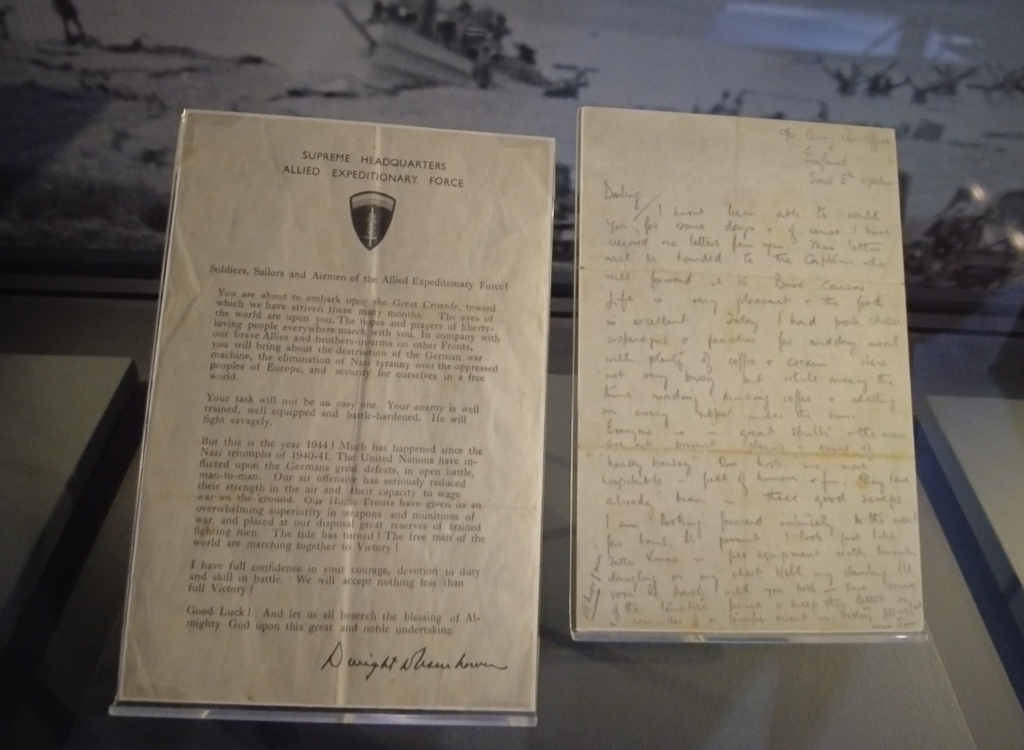
A letter by Eisenhower was intended to inspire every participating soldier in D-Day. It spoke of ‘a crusade’, of ‘hopes and prayers’ and having ‘full confidence in your courage, devotion to duty and skill in battle’. They were handed out as fighting men boarded aircraft and ships, like flyers in the high street. Lieutenant Colonel James Robert Morgan, second in command of the British 12th Light Anti-aircraft Regiment, used the reverse side to write home to his wife. He speaks of life being ‘very pleasant’ having ‘pork chops’ for lunch, everyone ‘in great spirits’ and ‘looking forward to a good scrap in the next few hours’. He ended with ‘I’ll soon be back with you both’, telling his wife to keep the letter ‘as a reminder of a terrific event in history’.
I couldn’t see if James came through the scrap safely, so I checked him up. He did. He was a Southend boy, who went on to lead his battalion in liberating towns and villages in France, Belgium and Holland, and was awarded the M.B.E.
Cauverville, near Caen, was one of those liberated villages. They have named a street after him, marking his gallantry for all time.
Visit HMS Belfast and make sure you listen to all the commentary. But do put yourself in the shoes of those men, look beyond any heroics but imagine the shells being fired at you, the bullets coming for you and the family waiting anxiously at home for you.
The Belfast, and all the Imperial War Museums, are not about glorifying war but the opposite, so visit the museums and see the terror of war, the horror of battle and learn from it.
IWM HMS Belfast until 11th April 2027
Booking and full details about accompanying film: https://www.iwm.org.uk/events/pressure-the-d-day-decision