The Eight Year Project
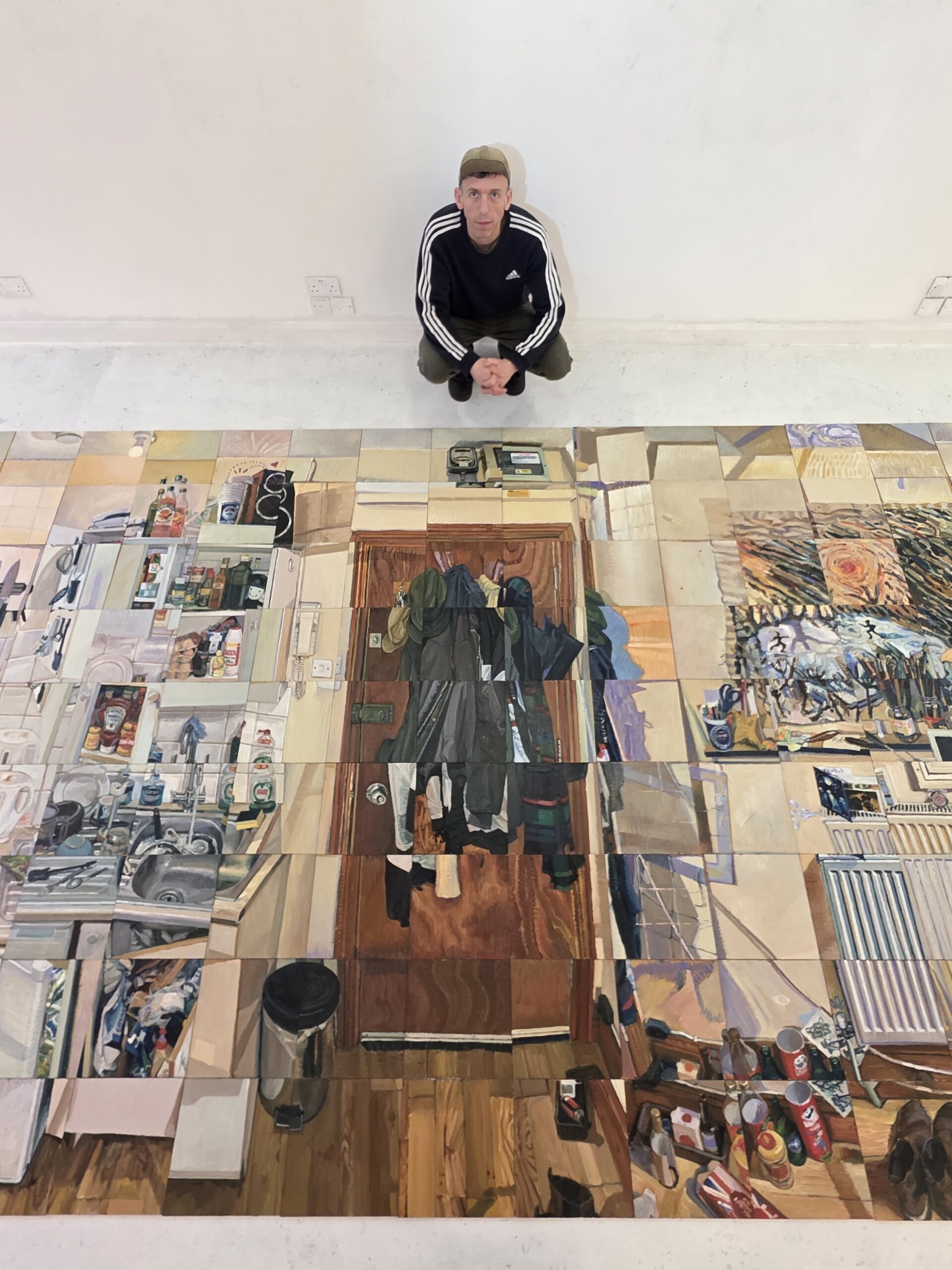
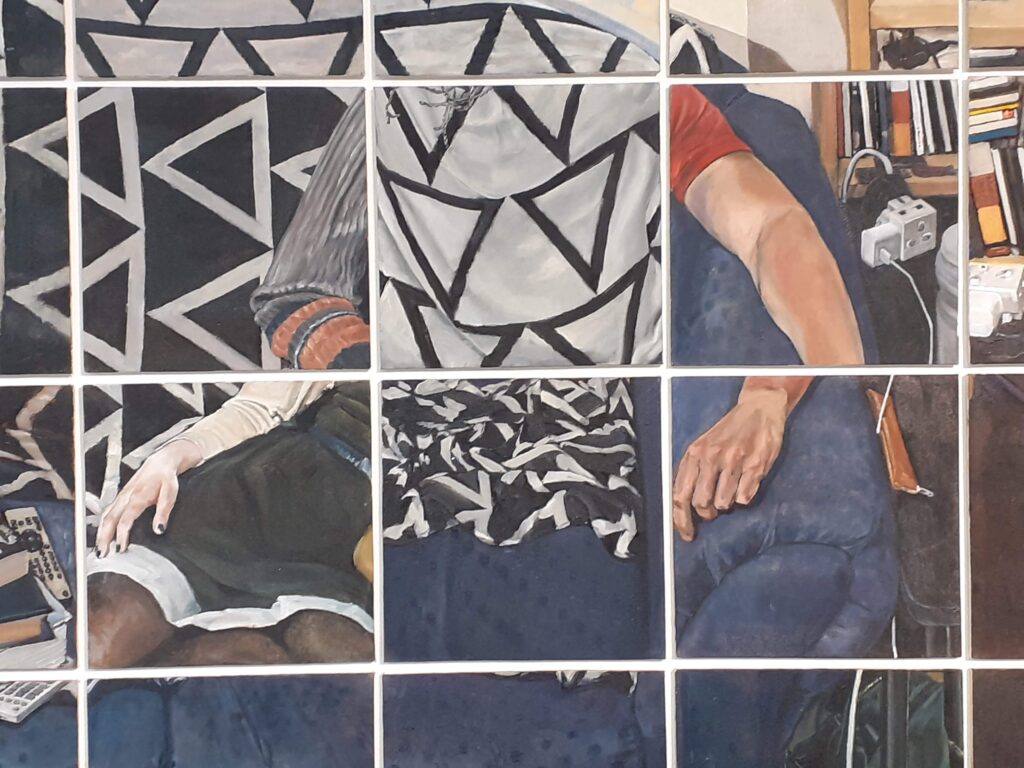
Rod Kitson has been painting his studio flat for eight years. Not some slow-burn decorating job but bit by bit. One square foot by one square foot, day-by-day, on board, as an art project, writes Michael Holland.
The artist explained that he once read what the price per square foot of land was in Bermondsey, so he began working to that size and charging by his hourly rate per square foot of artwork – like a builder. It is much cheaper than buying land…
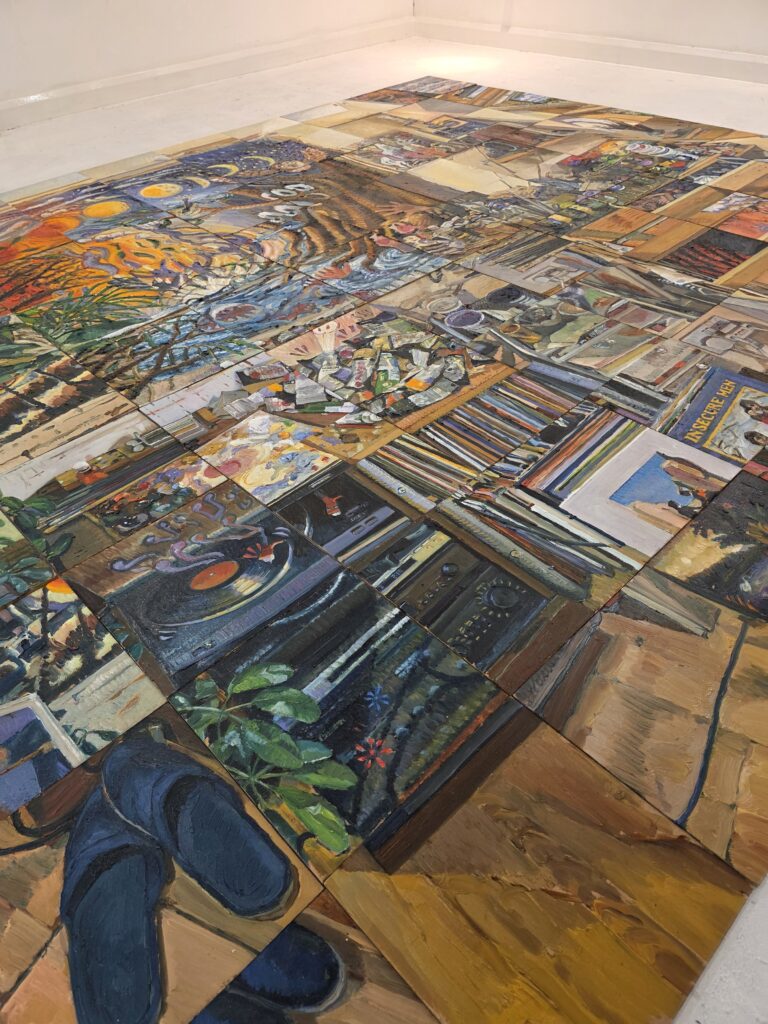
‘I began in 2018 and made nearly 200 squares from February to September,’ he begins. ‘In the early days, I worked on it for 190 days straight without a break, using a viewfinder to slowly piece together a life-size replica of my flat. A jigsaw of daily paintings which makes up a larger whole. I restarted in January 2025 and made another 225 up until November of that year. I am still working on it now… One square foot a day was a pragmatic approach to getting better at painting in the most efficient way. I was new to painting in 2018, and the best way to improve was to do it regularly. I looked at barriers: inspiration, procrastination, time, structure. This daily task of looking at one square of my flat and painting it took all of those fears and uncertainties out of the equation. It shut out the noise and allowed me to do the act of just painting. The size seemed doable. Not too big, not too small. And it was practical as the boards that I use come from B&Q as 6ft x 2ft. I didn’t want to waste materials or time, so I cut it into the most efficient size. And that’s how it’s been ever since. I have also done 600 portraits in the same size and even experimented with painting nude life models in sections. I used to replace the sections of the flat I sold by repainting the same space again. I have made around 1,500 paintings in this size. All cut by hand with a saw on wooden horses.’
Why?
‘The idea was to turn art practice into a work ethic, like turning up at the office every day. But now I see that no one works for 190 days in a row. It was compulsive and extreme. Rest is important to recharge the ideas and the freshness.’
What is the thinking behind the project?
‘It is about the evolution of an artist. It’s a then-and-now look at something that started as a rules-based and aesthetically flat way of working, through to a richer, more personal and fully formed collection of paintings.
I was debunking the myth of the artist. The myth of inspiration. The excuse for laziness. Resentment of the entitled, bourgeois artist trope, turned into action and production.
It is the comparison of the work as it was to how it is now. The 2018 collection are separate squares, individual artworks broken up by borders like grout in bathroom tiles, to one whole artwork with no gaps.
The old ones were for sale piece by piece, the new ones will not be broken up. It’s one artwork which is not separated by space between the squares. It’s symbolic and literal.’
How has the project helped you?
‘The methodology – the daily working, using a viewfinder to see what I was going to paint, the subject, the size – created a framework and structure which allowed me to work. Art is hard because there are no rules. That leads me into overwhelm, paralysis of options and ultimately avoidance.’
How has the artwork on the project changed in that time?
‘The exhibition is called Ascetic/Aesthetic, which is meant to show that there are two phases of the project.
Like the words, they look and sound similar but mean different things.
The first phase of the project, which was done in 2018 – the Ascetic part of the title – was a work strategy with little thought about the actual art of it. It was just about practising the act of painting daily and the hard rules I set myself: painting every day; not moving any of the objects that were in the viewfinder. In the trenches. Digging a trench. Army mentality. Masculine energy. Discipline.
I did not break the cycle of daily painting for 190 days. And when I did finally miss a day, I ended the project.
The second phase – Aesthetic – is the 2025 series where I came back with a much stronger artistic vision, which was playful and confident. I was not so hard-lined and saw the importance in the art and not the process. I do not hold myself to painting a piece every day because I know it’s not healthy and it doesn’t make the art good when I get burned out. I thought I was treating it like a job with the early series – but who goes to work for 190 days without a day off? A workaholic? Haha!’
How has your practice changed?
‘I am a lot kinder to myself and aware of what’s important to me. The priority is making good art, not a set of self-imposed rules that I cannot break. That approach helped, and did the job I set out for it to do, which was to get proficient at painting in the most efficient way. But I don’t need – or want – to work like that anymore. It’s not sustainable.
I am a much more confident artist. I am confident to actually call myself an artist and not feel like an imposter or arrogant about saying it. And that has made my work much richer.’
What do you hope happens with this exhibition?
‘I hope that people will enjoy it and I hope I will be able to enjoy other people enjoying it. If my process helps people think about strategies for getting through artistic block, fear, and procrastination, then that’s a bonus. Ambitions-wise, manifesting-wise, I would love for this to go on to be in the Turner Prize at the Tate. And be seen and enjoyed by as many people as possible.’
What are your plans after the exhibition?
‘Get back to my room and carry on painting! Lots of work still to be done. I’m looking forward to painting the bathroom and making that a metaphor for the shadow self. The annex. Lots of opportunity for dark suggestion and subversion in there with the mirrors, the medicine cabinet, and the toilet.’
The Art of Isolation, Upper Floor, Surrey Quays Shopping Centre, SE16 7LL. Free entry.
Hours: 11-6pm Weds-Sat; 11-5pm Sunday. March 13-25