Somewhere between the sacred and the everyday
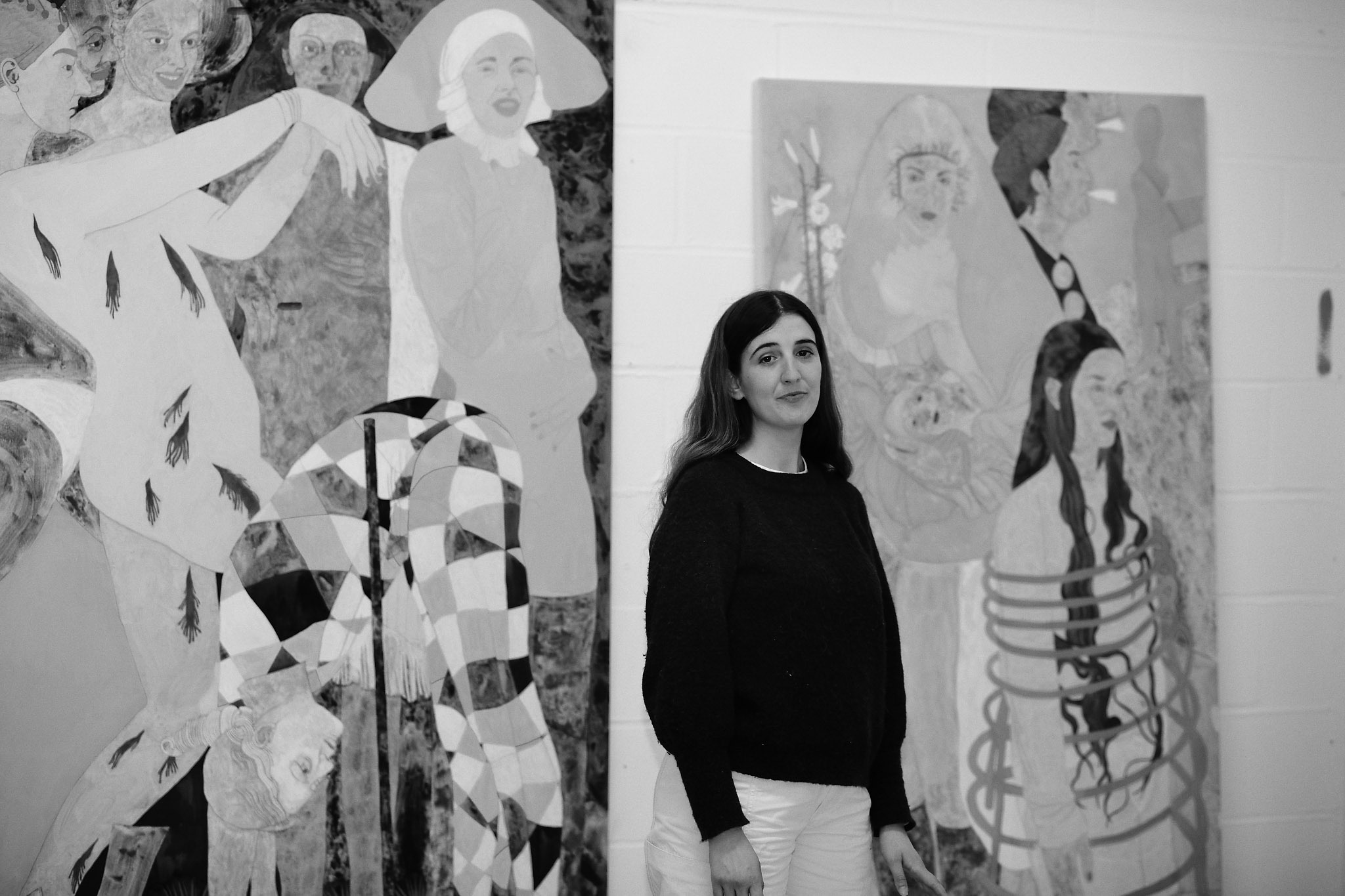
Manchester-born artist Ella Walker is the latest recipient of the Courtauld Commission. Walker has long explored the relationship between her work and the environments in which it is displayed. Her work often seems to exist outside of any fixed period. Renaissance-like compositions, colours, and poses are inhabited by contemporary faces that appear to leap from the canvas, collapsing centuries into a single image. For the Courtauld, Walker has created two new works, Verdaccio Wall, 2026, and The Studio, 2026, installed in the John Brown Entrance Hall and Ticket Hall, respectively, writes Leo Dunlop.
Verdaccio Wall greets visitors as they enter the gallery. Its flat, fresco-like surface and Botticelli-esque palette initially evoke another age, but the figures resist being placed so neatly in the past. Haloed women and solemn religious poses sit alongside modern clothing, creating an image caught somewhere between the sacred and the everyday, the historical and the contemporary. The figures’ eyes are difficult to escape. They pull you into the composition, leading your gaze between the bodies and through the arched forms of the painting, which echo the architecture around it. There is an intriguing incompleteness to the work too, as though its figures and symbols are still emerging from the wall.
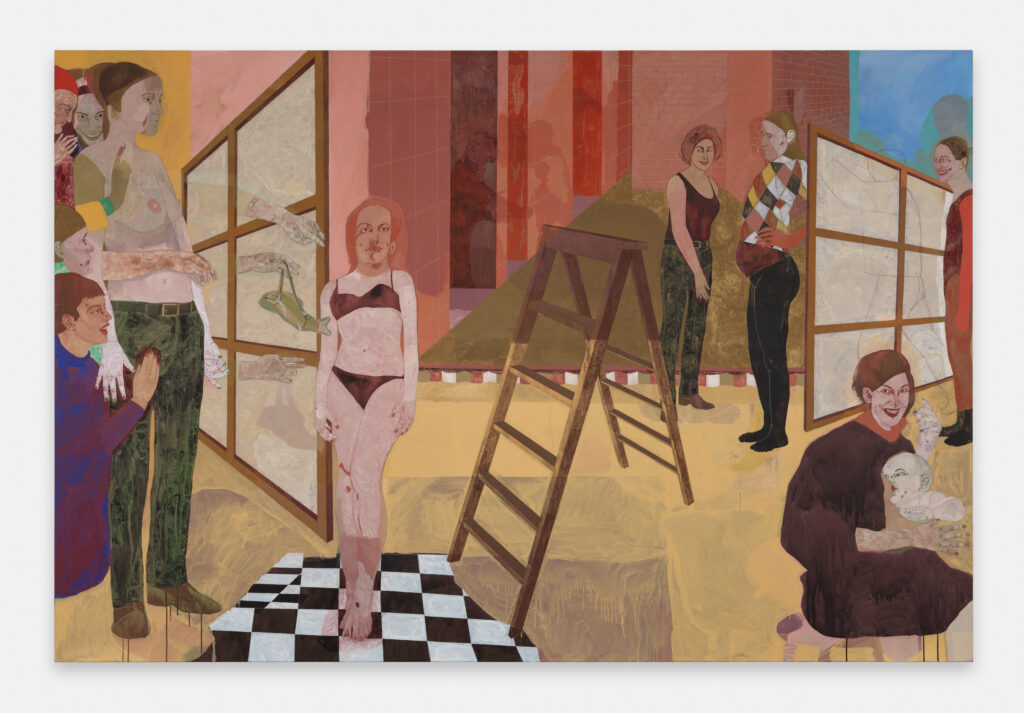
The Studio, above the staircase in the Ticket Hall, is stranger still. A long landscape stretches across the wall, populated by ghostly figures in Walker’s imagined artist’s studio. Rather than attempting to construct a coherent physical space, Walker uses a collage-like process to conjure its atmosphere. Figures overlap and drift into one another; hands and arms appear without obvious bodies; shadows occupy spaces where people might be. Ghostly smiles emerge from the composition almost as if they have been smuggled into it. The result is both playful and unsettling, a studio haunted by memories and references.
But the works’ most compelling relationship is perhaps with the Courtauld itself. Walker has drawn on paintings from the collection, bringing visual echoes of works hanging several floors above into the very spaces through which visitors enter the building. Yet this is not simply an act of homage. There is something more probing in the way Walker handles these inherited images. Her paintings borrow the visual language of the canon while subtly destabilising it, making us look again at the histories and structures behind the images we have been taught to admire.
That makes the choice of location significant. Having studied three years at The Courtauld, I know the efforts they have taken in recent years to confront its own institutional history and reconsider the structures through which its collection has been assembled and presented. Walker’s works bring that interrogation into the new commissions, a tension that shifts and tricks and makes the viewer question where they are.
There is something particularly striking about a young Northern female artist occupying this space and reshaping the traditions it represents. Walker does not reject the canon so much as enter into it, borrowing its colours, gestures, and compositions before bending them towards something more contemporary, ambiguous, and unsettling.
Her paintings are seductive enough to draw you in, and elusive enough to keep you looking. Perhaps that is their greatest achievement. They make the past feel strangely alive, not as something safely contained behind glass, but as something capable of looking back, to offer the space of revelation.
The Courtauld, Somerset House, The Strand, WC2R 0RN.
Details: https://courtauld.ac.uk/whats-on/?