A six-storey research centre to fight a deadly “global health threat” could open at the Paddington Basin in 2028. The plans were approved by the Westminster City Council Planning Committee on Tuesday (April 21).
The Fleming Centre will be the headquarters of an initiative to fight antimicrobial resistance (AMR), which is the resistance of diseases to antibiotics and other antimicrobials. It will be named after Sir Alexander Fleming, a Scottish biologist and pharmacologist who discovered the first antibiotic in 1928.

The Fleming Initiative
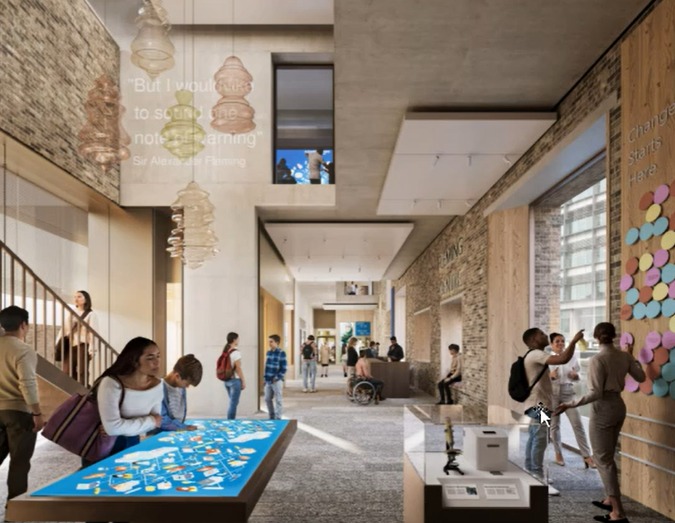
There will be free public exhibitions across the ground and first floors of the building. The ground-floor level, which will retain its current structure, will also have a café and public toilets.
Research facilities, a new laboratory, space for trials and workshops will be situated across the above floors. A terrace of 19th Century warehouses, called The Bays, will be repurposed and extended as part of the plans for the ground floor of the building.
The Fleming Initiative is a joint partnership between Imperial College Healthcare NHS Trust and Imperial College London. It will be the first in a planned global network of centres working to tackle AMR.
Chief Operating Officer at the Fleming Initiative, Amit Muji, told the committee: “[The centre] will be key in enabling the initiative to fully play its role to help stem the flow of one of the greatest global health threats of our time. This is a heritage led proposal, bringing the underused Bay Building back into meaningful public use.”
The 33-meter-tall building will also feature £250,000 of public art. Over 50 full-time jobs and training pathways will be created by the new centre, the applicant says.
The planning application will now be referred to the Mayor of London for final sign-off. If this is secured, the Fleming Centre is due to open its doors in 2028.
Lord Darzi, Executive Chair of the Fleming Initiative, said: “Planning permission for the Fleming Centre is a defining moment in our response to one of the great health threats of this century. Almost a hundred years ago, in a modest laboratory at St Mary’s, Alexander Fleming opened the antibiotic era. Today, that era is under threat. Antimicrobial resistance already claims more than a million lives a year and risks unwinding a century of medical progress.
“The Fleming Centre is our answer. It will bring scientists, clinicians, patients, policymakers and the public into the same rooms, asking the important questions – part discovery engine, part public square, part living laboratory. Alongside it, St Mary’s will grow into a fully integrated campus where clinical care, research, life sciences and education sit side by side.
“That this centre rises on the very ground where penicillin was discovered is not sentiment, it is intent. Where Fleming began, we begin again – this time, with the world watching.”