By Kumail Jaffer and Cameron Blackshaw
Estate regeneration schemes across London are leading to worsening living conditions, mass displacement and a loss of social homes, the Mayor of London has been warned.
Green Party Assembly Member Zoe Garbett has claimed in a new report that Londoners are still suffering from “the same failed model of estate regeneration” despite recent City Hall reforms aimed at boosting resident involvement.
From 2018, any landlord seeking to demolish social homes has needed to carry out a ballot of residents, while Mayoral guidance also suggests that there must be a net increase in affordable housing, as well as full rights to return or remain for social tenants.
However, Ms Garbett said that the system “continues to sideline residents and prioritise high-end market housing over meeting local needs”, leading to “degeneration”.
An estimated 139 estates are currently slated for demolition and redevelopment, or are currently undergoing regeneration, in London, with 160 such estates – comprising 55,000 households – have been ‘regenerated’ since 1997.
In her report, entitled “Left to Rot”, the Hackney Mayoral hopeful warned that the current system is failing social tenants, with research from the London Assembly Housing Committee in 2015 showing that 50 estates regenerated between 2004 and 2014 resulted in the net loss of around 8,300 social rent homes, despite the density of the sites doubling.
Classifications of affordable housing include shared ownership and intermediate rent schemes which don’t alleviate housing waiting lists in the same way as social housing.
She warned that communities also suffer from a “democratic deficit”, with residents not having the time, resources or accessible information to engage in the flawed process.
Questioned about the report last week in City Hall, Sir Sadiq Khan said: “We’re the only place in the country that requires that before a regeneration can take place, if people want funding from us, for there to be a ballot of people to make sure there’s an affirmative ballot before the regeneration can take place.
“What we also require in terms of planning if you’re going to demolish any affordable homes – which should be a last resort – they must be replaced with the same amount of affordable homes, if not more so. Planning and funding is something we do uniquely in London; other parts of the country don’t.
“The first thing I’ll do is read her report because it’s really important that we take on board concerns on a cross-party basis.
“The Better Homes for Local People guidance is quite clear in relation to demolition as a last resort and the rights of residents to refuse but I’m more than happy to receive her evidence about what’s happening in practice.”
Ms Garbett told the Local Democracy Reporting Service (LDRS) that she “welcomed his recognition of the issue”, but added: “I’m concerned that the policies he has implemented still aren’t protecting residents from some truly awful experiences.
“The report talks of people feeling they are left to rot, being left in limbo and degeneration. People also speak of the ‘joke of democracy’ as the processes aren’t fair or transparent. These are schemes funded by the Mayor of London, I really hope he reads the report, speaks to residents and takes urgent action.”
Recommendations in the report include reforming resident ballots to better hold landlords to account, creating a ‘Community Plan Fund’ to drive resident-led regeneration, and adding conditions for any Greater London Authority (GLA) funding to ensure investment partners do not displace residents.
Trouble in Thamesmead
One estate currently facing regeneration is the Lesnes Estate in Thamesmead, famous for featuring in the 1971 film A Clockwork Orange. Bexley Council rubber stamped plans in December that will allow housing association Peabody to demolish the 1960s estate and build up to 1,950 new homes.
Many have left the estate ahead of its destruction, but several residents who have called Lesnes their home for decades are refusing to leave. They feel threatened by Peabody despite the housing association offering them financial support to move elsewhere.
Andrea Gilbert is a housing activist and Lesnes resident who has been battling through her estate’s regeneration process. She was critical of how Peabody had been communicating with those still on the estate, explaining that many of them felt unsure of their futures and how long they would have until they were forced to move.
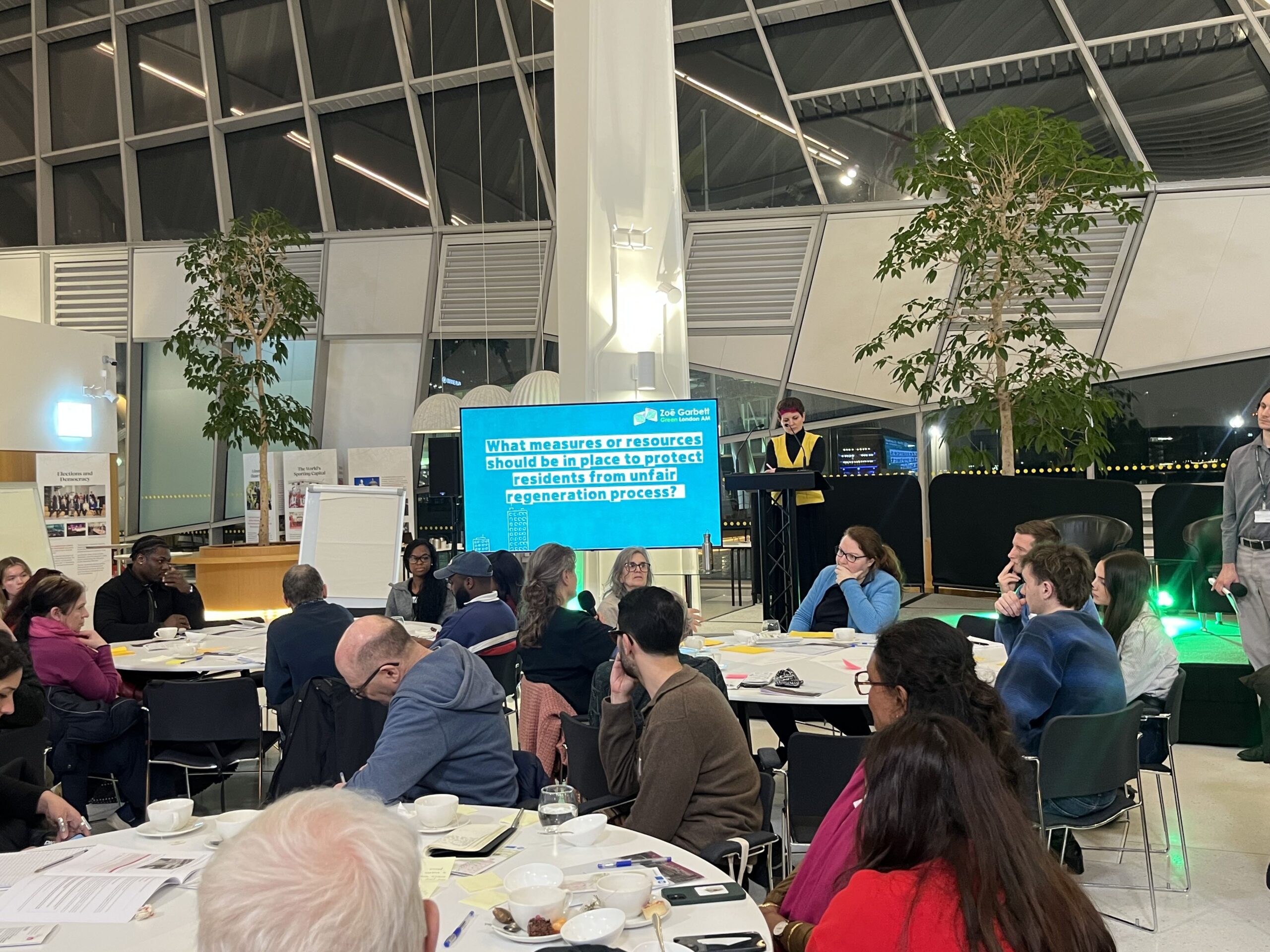
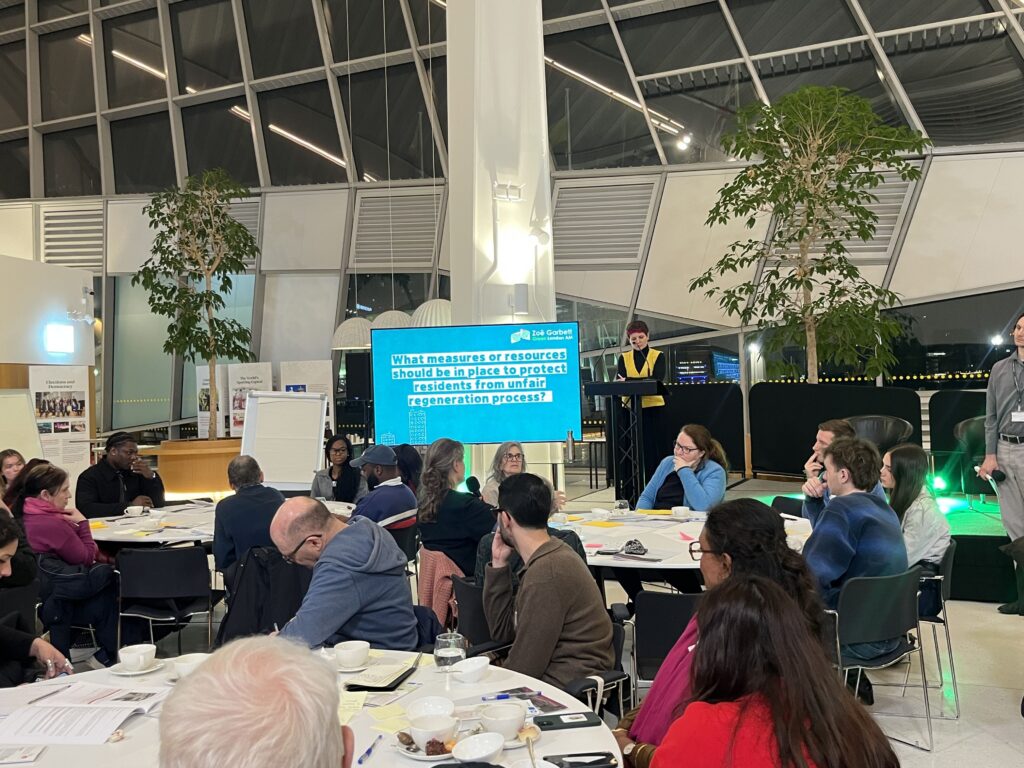
Andrea, who attended Ms Garbett’s estate demolition and gentrification event in City Hall last month, told the LDRS: “Residents are still being forced to fight to stay in their homes until the very last moment. Even for those pushed into negotiations with Peabody, it takes weeks, sometimes months just to secure local viewings for suitable three or four-bedroom homes under like-for-like terms, followed by further delays before they can even move in.”
One Lesnes resident has launched a legal challenge to overturn the 1,950 homes plan. Adam Turk lodged a claim for a judicial review of Bexley Council’s approval decision earlier this year, citing unlawful environmental information provided in Peabody’s planning documents.
Mr Turk said he and the other remaining Lesnes residents were “very hopeful and excited” about the proposition of the decision being overturned. He added: “It doesn’t matter if we’re homeowners, leaseholders or social tenants. We’re all residents and we all just want to stay here.”
Peabody has offered the remaining Lesnes residents financial support to buy another home nearby or elsewhere before the estate is demolished. It is offering residents the market value of their home plus 10 per cent as compensation. The housing association is also willing to bridge potential price gaps between current and new homes by contributing up to half of the equity.
The housing association thinks the redevelopment of Lesnes will benefit the entire Thamesmead community as the 596 homes demolished will make way for 1,950 new ones, a near 230 per cent increase in available housing.
Credit: Heather Abdule/Green Party
It also believes that many in Thamesmead back their plans to regenerate the area. A ballot carried out in 2020 by Peabody stated that 70.2 per cent of residents on the Lesnes Estate wanted it to be included in the housing association’s wider plans for South Thamesmead, with 65.4 per cent of residents taking part in the ballot.
A Peabody spokesperson previously told the LDRS: “We’re investing in communities in and around South Thamesmead, supporting people, improving public areas and providing much-needed new homes.
“The planned redevelopment of the Lesnes Estate will help us expand this work and create an even better place for local people to live. We’ll respond to legal enquiries around the planning application, and will continue to support residents during this period of transition.”