This exhibition centres around a work that proposes to allow “the desert to look at itself”.
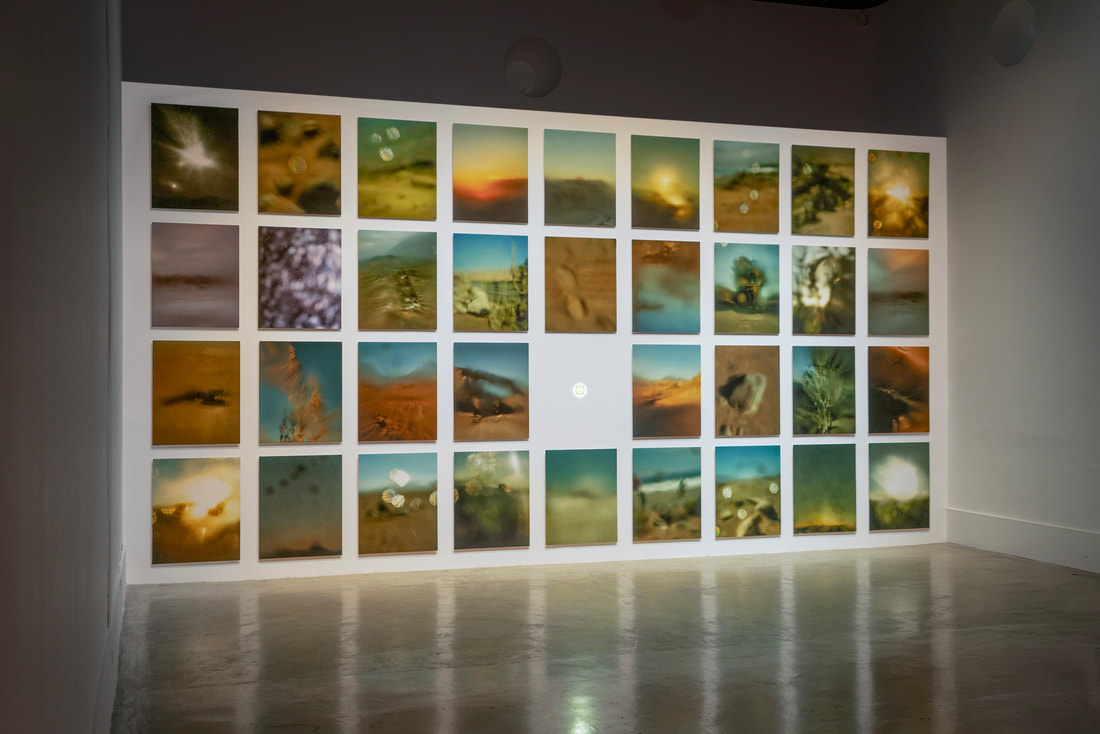
In the history of art, just about everything possible has been done to both subject and image in the context of photography, but the crucial thing it all passes through – the lens – has remained largely unaltered. Solaris (2025) is the culmination of a long-standing body of research and refinement, comprising 35 printed images and a single special lens that span an entire wall of the Copperfield gallery.
This installation emerges from the Atacama Desert, the driest place on Earth and one of the world’s best-known locations for astronomical observation. Over time, this vast territory has been inhabited by diverse cultures and communities, and today it is home to some of the most powerful sets of lenses in the world, but these are inevitably pointed to the heavens, with their location a mere irritation to those who wield them.
For this work, the artist collected Atacama sand, which was melted down and turned into glass. That glass was then painstakingly transformed into photographic lenses which are correctly fashioned, but hold within them all the particularities of the minerals of this special place. These “eyes of the desert” were taken back to the Atacama and used to photograph the environment itself. The ecological traces of the territory are directly present because the sand was not purified before being melted and turned into glass, and they distort the resulting images, showing us the desert through itself.
Inspired by Stanisław Lem’s novel of the same name, in which a form of planetary intelligence manifests itself as a conscious ocean, the images and the lens here propose an act of self-awareness: the desert may see itself and we may see it through its own eyes. But of course, it cannot as it would have to be sentient, and that is not an attribute that we humans have awarded the desert with.
If the collision of things like quantum physics, deep ocean exploration and AI have taught us anything in recent years it is that the rules, boundaries and specifications that humans have decided and relied upon as immalleable fact are not as fixed as we once thought. We are finding the limitations of our certainties.
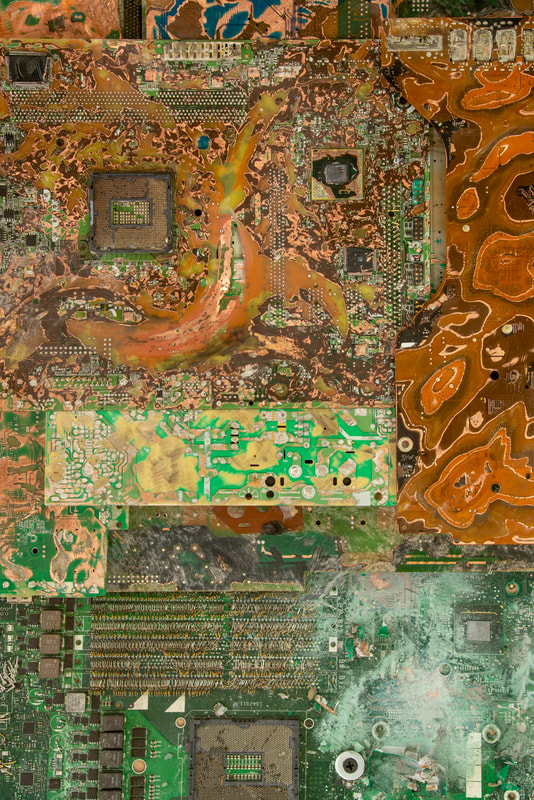
Accompanying works like Placenta (2026) underline the impossibility of detaching ourselves or our technologies from nature, of ignoring it, or of the arrogance of thinking we totally understand it. Taking computer motherboards as its basis, the artist strips the machinery of its function by sanding and eroding its components until its surface reveals an uncharted landscape. Electronic nodes transform into mineral-like patterns, exposing a sort of “technogeology.” The boards appear less as instruments of computation than as fragments shaped by planetary transformation: incredibly sophisticated devices that will eventually be metabolized back into raw matter. Through this process, Santillán melds the technological and the geological, creating an almost hallucinatory terrain of machine, mineral, and earth.
Copperfield, 6 Copperfield Street, London, SE1 0EP.
Opening Wednesday 27 May 6-8:30pm
Runs weekly, Wed – Sat, 12- 6pm until 1 August 2026