New exhibition stirs old masters into a bold mix of abstraction and play
Dulwich Picture Gallery’s new display doesn’t belong to time past, present or future – but to time overspilled and cheerfully tangled: Time Spaghetti, writes Emily Driver.
The works by Lisa Contucci, Clifton Wright and Stanley Ganton stage a new kind of conversation for the gallery, held, not over a dinner table, but across eras. When sharp and sustained, they prompt us to consider the gallery’s old masters with a fresh set of devouring eyes.
Contucci’s process-driven art begins from photographs of works around the gallery. From here, the dramas of the Baroque are translated into ultra-abstract colourscapes. That is not to say that Contucci’s art is not a drama of its own, but rather that her artworks display a drama of colour, texture and movement. In these swishes and swirls lies the trace of the original mood of inspiration: a keen eye might spot the pale blue of Antonlínez’s skyline awash in her canvas, or Poussin’s peach-clad ladies reincarnated as splodges adrift upon a scheme of colours enhanced and transposed.
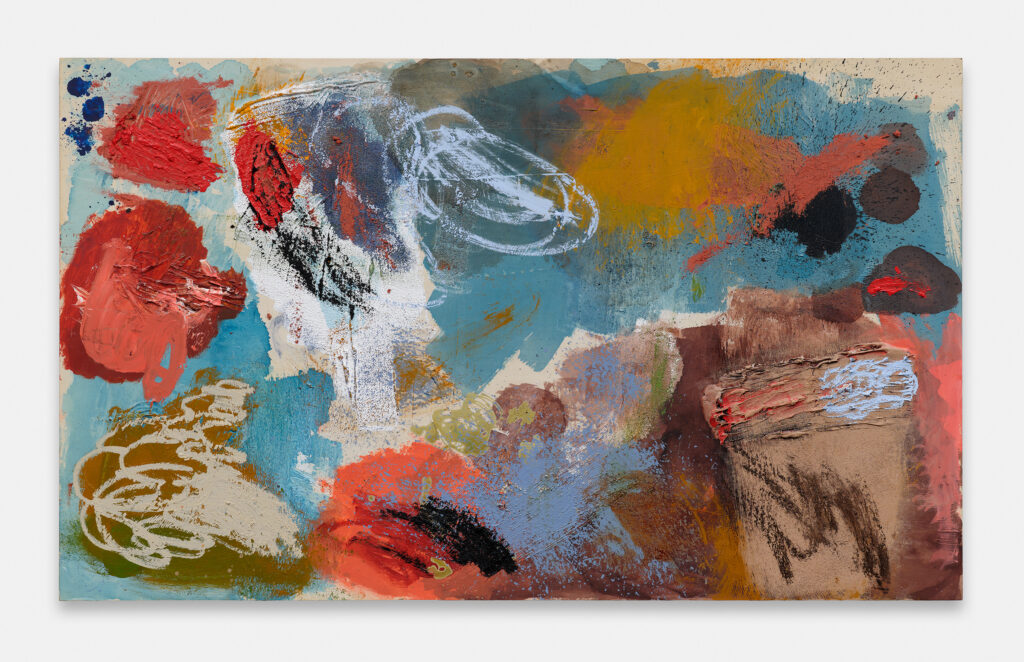
The best works by Contucci are the ones that give full rein to the physicality of her materials. The choice to leave her marbled canvas visible in peeks and stretches allows for an exploration of tone and surface. Dimensionality is added by acrylic, which pools into islands, and rough marble dust, which grazes the gaze. It’s art that invites immersion as well as observation; where this textured richness lapses, the paintings pack less punch.
Wright’s oils and pastels teeter somewhere between abstraction and familiar forms. His large, multi-canvas compositions depict bodies that seem both connected and disjointed. Exaggerated heads, miniature limbs, and jagged triangular forms rest on striking and distinctive handmade coloured paper. Wright’s engagement with the gallery’s collection shifts between irreverence and sincerity. Sometimes Christ with the cross becomes a skull in front of clashing swords (a pirate’s flag, perhaps?). Sometimes he still carries that anguished load through his eyes, and holiness shines through in the smokey black lines that hold the fracturing quality of a Cathedral’s stained glass. It is a stunning visual language that opens itself up the more you look.
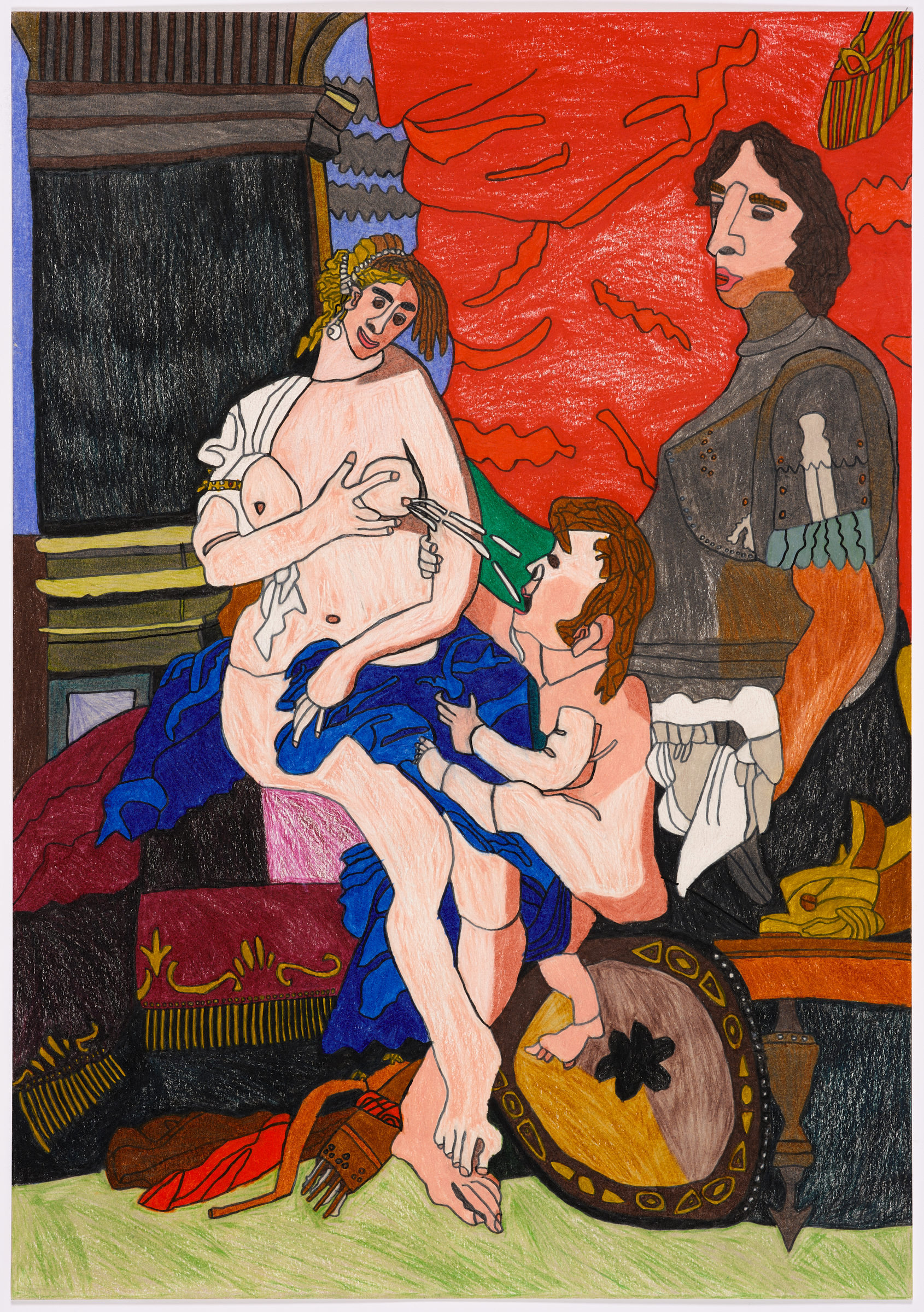
Closest in proximity to its Old Master sources is Ganton’s art – quite literally, hung beside them in the gallery. Flattening Lely’s and Rubens’ scenes of refined sensuality into angular, unmodulated blocks of colour, he unearths the bones beneath the Baroque’s romanticised sheen. For some visitors, this bluntness might enervate the room’s flow; for others, it energises the originals with playful and humorous rapport.
Time Spaghetti thrives on its premise: a lively jumbling of centuries, styles and sensibilities. The full flavour emerges if you commit to seeking these tangled connections (the folders in the room help point you to each work’s counterpart) – but even without them, the display stands strong. Wright’s pieces feel most self-sufficient, while Ganton’s contribution, with only two works beside their sources, feels a little undercommitted. In any case, under three varying artistic temperaments, familiar traditions become sites of questioning and rethinking, and, at their best, fresh affirmation. Together they remind us time isn’t just measured by the clock, but how it can be twirled, tangled and served anew.
Dulwich Picture Gallery, Gallery Road, London, SE21 7AD until January 11th 2026. Tuesday – Sunday, 10am – 5pm.
Full details: https://www.dulwichpicturegallery.org.uk/