More than a million homes in London may need significant upgrades to help curb the capital’s overheating crisis, the London Assembly has heard.
The city’s properties are particularly vulnerable to heat due to the urban heat island (UHI) effect, a phenomenon where higher temperatures are experienced in built-up areas due to the heat-absorptive properties of buildings and roads.
However, City Hall has instructed developers, through the London Plan, to prioritise “passive” cooling measures such as shading rather than allowing the installation of air conditioning (AC) by default.
Experts suggest that the impact of climate change – particularly the rise in temperature – means modernising homes, which are traditionally built to retain heat in the winter, is more important than ever.
Credit: London Assembly
The 2022 heatwave saw record temperatures recorded across the UK, with London hitting 40°C that July. Throughout the year, there were 3,271 heat-related deaths in England, 387 of which were recorded in London.
Social tenants are bearing the brunt of the capital’s overheating homes crisis, according to the Resolution Foundation, with 74 per cent of social homes considered to be at high risk of overheating.
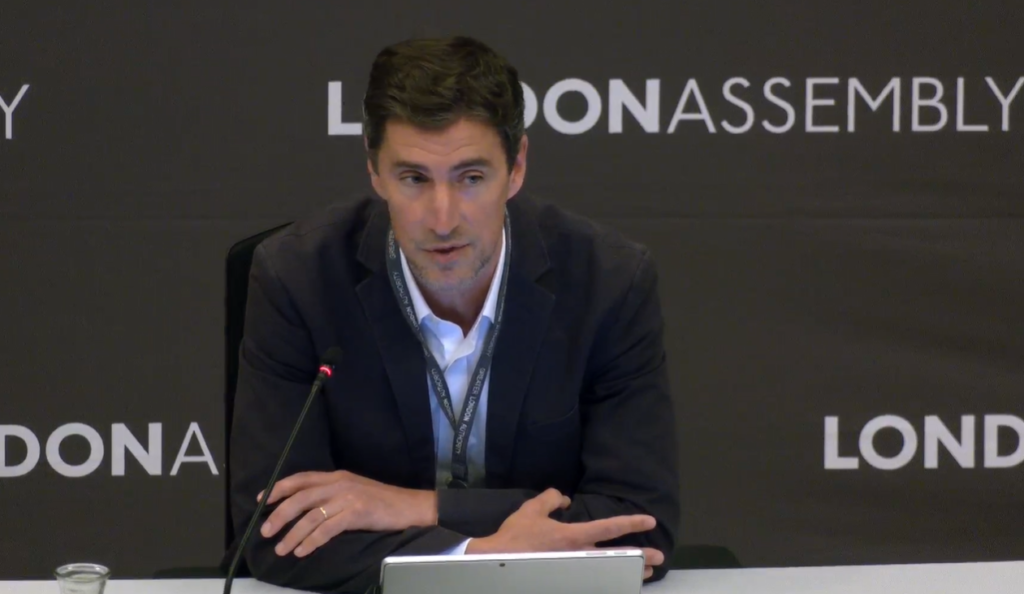
Dan Bicknell, Climate Adaptation Manager at the Greater London Authority (GLA), admitted that City Hall has a “lot to do” to bring the city’s homes up to scratch.
“It’s fair to say we are in the early days of this process,” he told the London Assembly Planning and Regeneration Committee earlier this month. “We’ve made a strong start by understanding the risks. We’ve published a report which gives an idea of where we need to target our efforts.”
He said that retrofitting London’s homes for heat adaption would be a “really expensive process..in isolation” and said the GLA would “need to join it up with other activities to make sure it’s viable”.
“Otherwise, it just won’t happen – it’s likely to be too expensive. The number of properties is likely to be over a million existing properties in London that need to be retrofitted for heat in the sort of medium to long term.”
This would mean combining current programmes which aim to upgrade London’s homes to ensure they are warmer in the winter and more energy efficient throughout the year.
However, Mr Bicknell also admitted that there was a “huge funding gap” towards retrofit programmes in general. The GLA is set to publish its long-awaited Heat Risk Delivery Plan this summer, a city-wide framework designed to manage extreme heat and overheating.
At the same meeting, the Deputy Mayor for Planning, Jules Pipe, was keen to point out that there was no de-facto ban on AC in new London properties at the moment, but that City Hall was keen to prioritise passive measures that used less energy before turning to “active cooling”.

Credit: London Assembly
“There is no ban on AC – I would invite anyone to point out in the London Plan where there is any wording that prevents it in new build developments,” Mr Pipe said.
“All the plan says is to maximise passive measures that cost tenants nothing and then if it doesn’t meet the required standard, it doesn’t prevent you from installing AC. It is to prevent that need to turn it on.
“The cooling hierarchy requires developers to maximise passive measures – designing the building not to overheat in the first place. If AC is required not to exceed uncomfortable temperatures, then there’s no problem.
“The greening policies in the current plan were ambitious – we are keen the next plan is equally ambitious. The action that the world is taking on climate change isn’t sufficient. There will be situations where buildings don’t lend themselves well to passive measures.”